Write Like a Thought Leader: Elizabeth Gilbert Shows Why You Must Choose Your Book’s Engine
Most authors think genre is a marketing decision.
It isn’t.
It’s an architectural one.
Elizabeth Gilbert’s career makes this unavoidable. Half her readers love Eat, Pray, Love. Half love Big Magic. Same author. Completely different books.
The difference isn’t tone.
It’s engine.
This is the Engine Decision Rule: choose the dominant force that carries the reader experience.
This elevates the doctrine without adding structure.
Gilbert chose the core engine of each book, memoir or thought leadership, and everything else flowed from that decision: structure, audience experience, and downstream opportunity.
If you don’t choose the engine early, the manuscript fractures.
Cleaner. Less rhetorical flourish. More structural authority.
The Split Reaction: Which Elizabeth Gilbert?
Ask people what they think of Elizabeth Gilbert and you’ll often get two very different answers.
One group talks about Eat, Pray, Love like it’s a mirror:
“I felt seen.”
“It captured something I couldn’t articulate.”
The other group talks about Big Magic like it’s fuel:
“It changed how I think about creativity.”
“It made me act.”
Same author.
Two completely different reader experiences.
That split isn’t accidental.
It’s structural.
The Trap: Trying to Write All Three Books at Once
Most authors don’t fail because their ideas are weak.
They fail because their engine is confused.
They try to write:
- A memoir
- A lesson book
- A novelistic narrative
All inside one manuscript.
The result feels unfocused.
It has stories, but no immersive arc.
It has ideas, but no structured progression.
It has scenes, but no teaching spine.
Even strong material collapses under genre ambiguity.
When the engine is unclear, the chapters resist cohesion.
What Makes Big Magic Thought Leadership
Big Magic works because it teaches.
Its engine is instructional.
You can see it in the structure.
Reframe First
It begins by redefining the problem.
Fear isn’t mystical.
It’s ordinary.
It’s predictable.
The book opens by shifting interpretation.
Principles Drive the Chapters
Each section advances a clear claim.
The argument progresses through principles, not chronology.
Stories Support, They Don’t Lead
Personal anecdotes appear as evidence.
They illustrate the idea.
They are not the engine.
Application Is the Outcome
Readers leave with permission and practice.
Not just inspiration.
But direction.
That’s thought leadership.
It reframes.
It structures.
It teaches.
What Makes Eat, Pray, Love Creative Nonfiction
Eat, Pray, Love works because it immerses.
Its engine is narrative.
You can see it in the design.
A Bounded Time Frame
One year.
A contained arc.
Not a whole life story.
Scene + Reflection Rhythm
Experience first.
Meaning second.
The reader watches transformation unfold.
Immersion Over Instruction
There is no framework.
There is no structured lesson.
The power is proximity.
Internal Drama Drives Momentum
The tension is internal: longing, identity, reinvention.
The pages turn because the reader wants emotional resolution.
That’s creative nonfiction.
Connection precedes instruction.
Two Genres: Two Business Models
Engine choice doesn’t just shape the reading experience.
It shapes the opportunity that follows the book.
Eat, Pray, Love expanded as story.
It led to:
- Film adaptation
- Global media presence
- Travel and cultural expansion
Those opportunities emerge naturally from narrative.
Stories scale through adaptation and emotional resonance.
Big Magic expanded as teaching.
It led to:
An evergreen thought-leadership platform
- Workshops
- Speaking
- Creative community
Who You Write For Shapes What You Can Build
Genre defines reader expectation.
Creative nonfiction readers want:
- Emotional resonance
- Identification
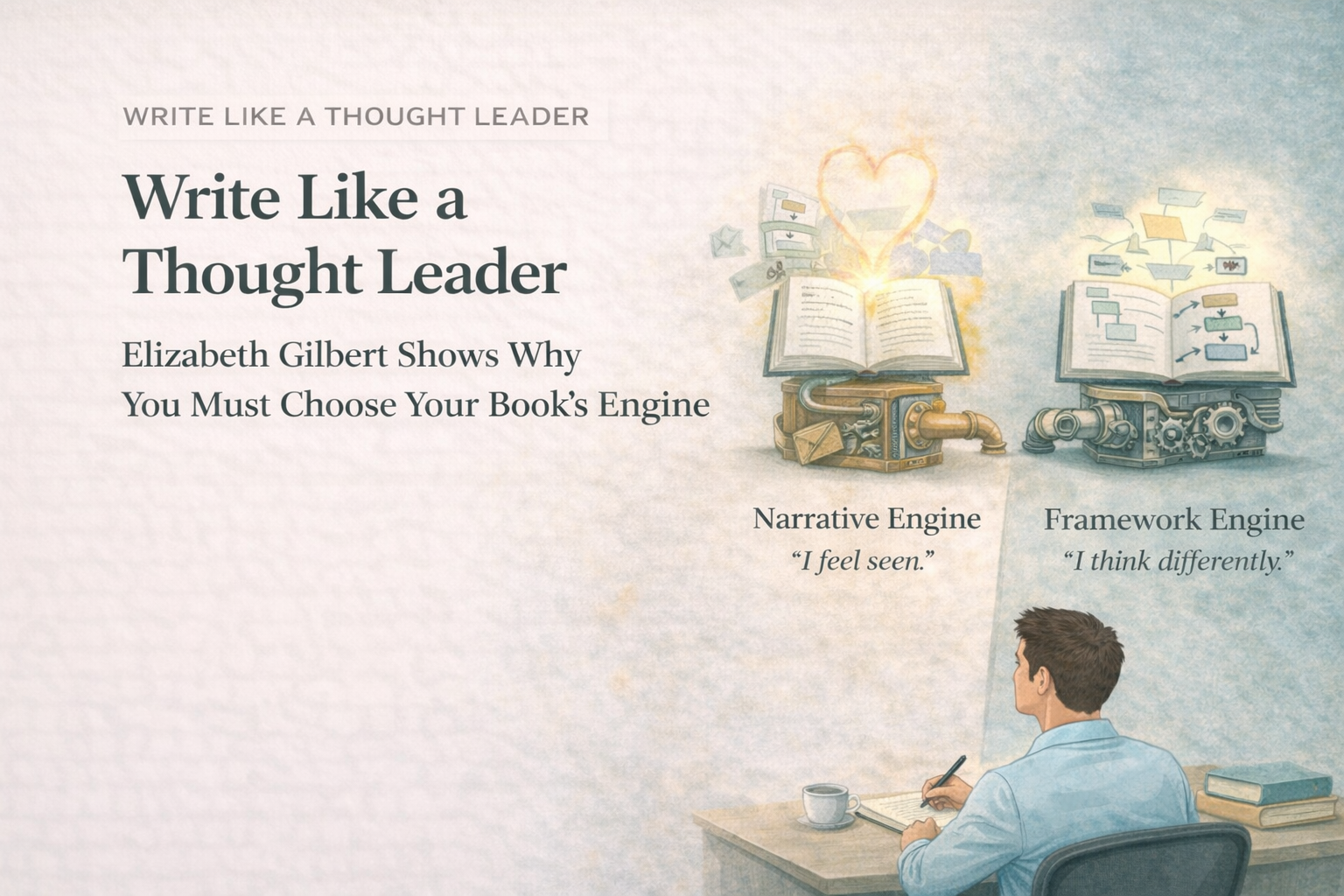
- “I feel seen.”
Thought leadership readers want:
- Distinctions
- Frameworks
- “I think differently.”
If you blur the contract, friction appears.
If someone expects immersion and receives instruction, it feels preachy.
If someone expects instruction and receives scenes, it feels unfocused.
The engine determines what the reader is here to receive.
The Steve Fredlund Example: When It Doesn’t Feel Right
Sometimes the writing is strong.
But the genre is wrong.
Steve Fredlund initially wrote philosophy.
The ideas worked.
But it didn’t feel authentic.
The structure was instructional. The voice wanted immersion.
He pivoted to memoir.
The insight:
Even a strong draft can misalign with your natural engine.
When genre matches voice, the work flows.
When it doesn’t, friction multiplies.
The Core Decision Framework
Before drafting, decide the engine.
Not the topic.
Not the tone.
The engine.
Every serious book runs on one of two core forces:
The Mirror
The reader sees themselves.
- Emotional immersion
- Scene-driven progression
- Internal transformation
- “I feel understood.”
The power is recognition.
The story carries the insight.
The Map
The reader sees a path.
- Distinctions and reframes
- Principle-driven sections
- Stories as illustration
- “I know what to do.”
The power is clarity.
The framework carries the insight.
If the reader can’t tell whether they’re here to feel or to learn, clarity erodes.
Ask three questions:
- What should readers say the day after finishing?
- What experience should dominate: immersion or instruction?
- What do you want this book to unlock after publication?
This reinforces operational clarity without adding new sections.
The Only Question That Matters
When someone finishes your book, which sentence should be true?
“I feel seen.”
Or
“I think differently.”
Choose the outcome.
Then build the engine around it.
The Real Lesson from Gilbert
Elizabeth Gilbert didn’t ask:
“What do I want to say?”
She asked:
“What does this book need to be?”
Each book had:
- A clear engine
- A clear audience
- A clear structural form
That’s why both succeeded.
The lesson is structural:
Choose the engine first.
Structure, audience experience, and opportunity follow.
What This Means for Writing Like a Thought Leader
Thought leadership books don’t start with content.
They start with the engine.
Decide the reader experience first.
Then design the structure that delivers it.
That means:
Choose immersion or instruction
Build the manuscript around that choice
Let stories or frameworks carry the reader journey
Thought leadership isn’t about having ideas.
It’s about choosing the mechanism that makes those ideas travel.
That’s what Elizabeth Gilbert understood.
And that’s why her books work.
Quick FAQ
Can a book mix memoir and thought leadership?
Yes, but one must still be dominant. The engine must remain clear.
Why does genre confusion weaken books?
Because readers expect a specific experience. If the contract is unclear, the structure feels inconsistent.How do I choose my book’s engine?
Decide what the reader should say after finishing: “I feel seen” or “I think differently.”
→ Schedule Your Free Strategy Call
About the Author
Eric Koester is an award-winning entrepreneurship professor at Georgetown University, bestselling author, and founder of Manuscripts, the Modern Author OS used by more than 3,000 authors. His work has helped creators turn ideas into books, books into brands, and brands into scalable businesses.
About Manuscripts
Manuscripts is the leading full-service publishing partner for modern nonfiction authors. We help founders, executives, coaches, and experts turn their books into growth engines, through positioning, coaching, developmental editing, design, AI-enhanced writing tools, and strategic launch systems. Manuscripts authors have sold thousands of books, booked paid speaking gigs, landed media features, and generated millions in business from their IP.
Work With Us
If you’re writing a book you want to matter, let’s map out your Modern Author Plan.
Schedule a Modern Author Strategy Session → https://write.manuscripts.com/maa-web
Explore Manuscripts Publishing Services → https://manuscripts.com/publish-with-us/
See Modern Author Success Stories → https://manuscripts.com/authors/
Modern Author Resources
- How to Write a Book if You’re Busy
- Modern Ghostwriting for Nonfiction Authors
- AI Tools for Authors in 2026
- How to Build an Audience Before You Write Your Book
- The Evergreen Launch System for Modern Authors
Powered by Codex: The Modern Author Author Intelligence Tool