

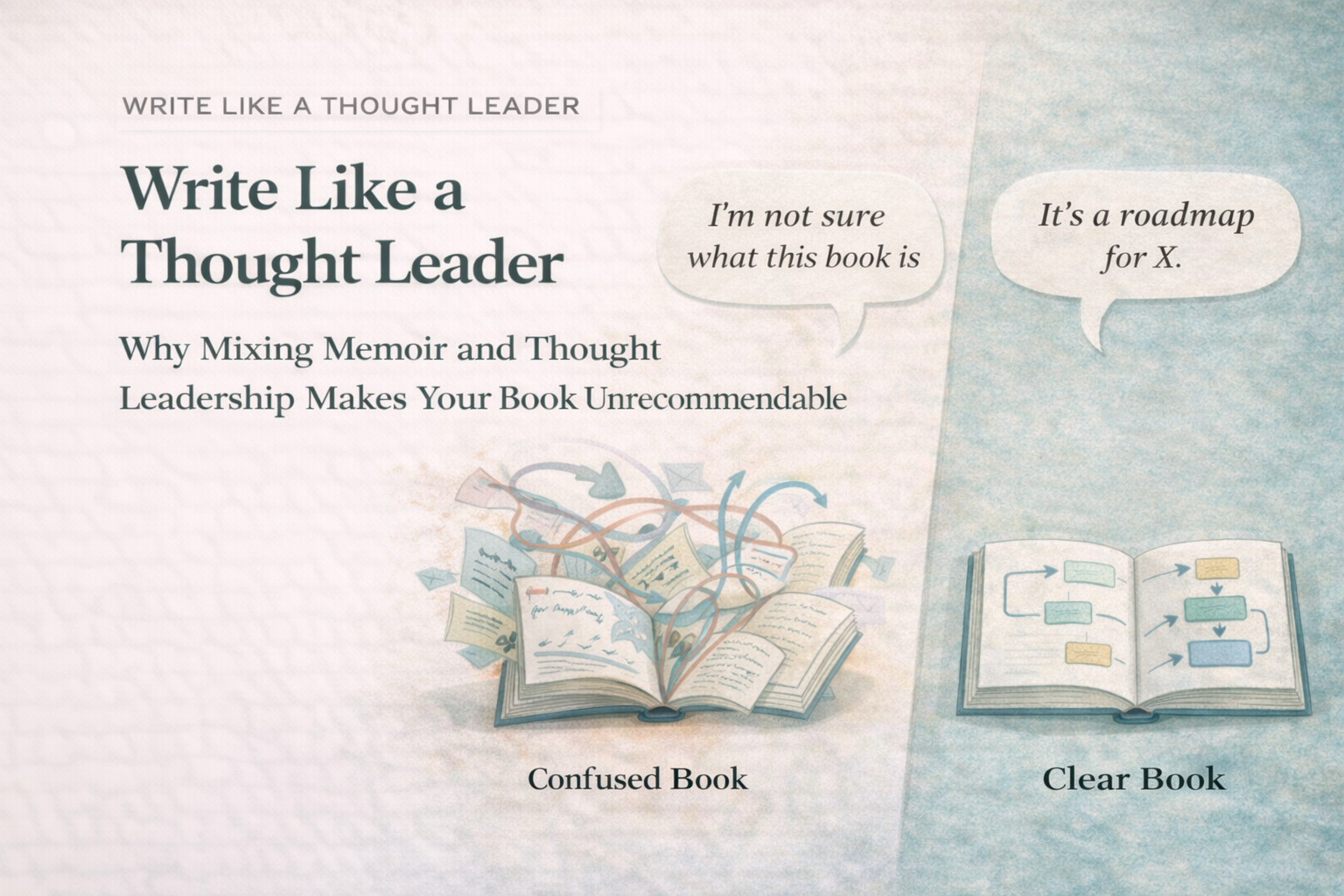
Write Like a Thought Leader: Why Mixing Memoir and Thought Leadership Makes Your Book Unrecommendable
Most authors think their manuscript isn’t working because it needs better writing.
It doesn’t.
It needs a category decision.
Trying to write memoir, creative nonfiction, and thought leadership in the same book doesn’t make it layered.
It makes it unrecommendable.
Readers don’t struggle because your ideas are weak.
They struggle because they can’t categorize the book.
If they can’t categorize it, they can’t describe it.
If they can’t describe it, they won’t recommend it.
The fix isn’t more polish.
It’s choosing one clear book type, by designing for the reader: who it’s for and what they’ll say after reading.
The Symptom: “I Don’t Know What Kind of Book I’m Writing”
You hear it constantly:
“I’m not sure what this is yet.”
The manuscript contains:
- Personal stories
- Big ideas
- Narrative scenes
- Lessons and takeaways
Individually, they’re strong.
Collectively, they’re confused.
The author doesn’t lack material.
They haven’t made the category decision.
Without a clear type, the book has no engine.
And without an engine, it can’t move cleanly in one direction.
The Real Failure Mode: The “Me-First” Book
The deeper problem isn’t genre ignorance.
It’s starting from the wrong center.
A “Me-First” book begins with:
“What do I want to say?”
That question invites everything in.
Your story.
Your lessons.
Your reflections.
Your commentary.
The manuscript expands sideways instead of deepening.
The corrective question is sharper:
“What do my people need to hear, and how am I uniquely qualified to say it?”
That shift changes the organizing principle.
When the reader becomes central, category clarity becomes unavoidable.
Because readers don’t recommend books based on your self-expression.
They recommend them based on what the book did for them.
The Core Rule: Books Spread Through Recommendability
Books don’t spread because they are profound.
They spread because they are describable.
A reader finishes and says:
“It’s like a roadmap for X.”
“It felt like someone finally understood Y.”
“It’s a framework for navigating Z.”
That sentence is the spread mechanism.
If the book cannot be summarized cleanly, it cannot travel.
This is the diagnostic:
What will readers say about your book the day after they finish it?
If the answer is vague, the engine is vague.
Recommendability requires clarity.
Clarity requires choosing a type.
The Three Book Types (And Their Engines)
Most nonfiction books fall into one of three dominant reader experiences.
Not genres in the publishing sense.
Engines in the structural sense.
Each engine organizes the manuscript differently and produces a different kind of reader response.
Choose the wrong engine, or try to combine all three, and the reader loses the thread.
Choose the right one, and the book moves with clarity.
Thought Leadership
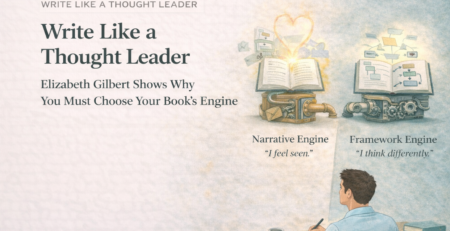
Engine: Idea → Framework → Application
- Clear thesis
- Repeatable language
- Structured progression
- Stories as illustration
- Problem–solution orientation
Reader response:
“I think differently.”
“I know what to do.”
It teaches.
Creative Nonfiction
Engine: Immersion → Meaning
- Scene-driven narrative
- Emotional progression
- Reflection woven into story
- Indirect teaching
Reader response:
“I felt that.”
“I see myself in this.”
It connects.
Memoir
Engine: Personal Arc → Identity Mirror
- Vulnerable through-line
- Intimate access
- Voice-centered
- Transformation anchored in lived experience
Reader response:
“I understand this person.”
“I see parts of myself in their journey.”
It mirrors.
You can borrow elements from each.
But one must dominate.
The Constraint: You Can’t Mix Engines Without Breaking Clarity
Here’s the structural constraint most authors miss.
Reader experience depends on a stable engine.
When the engine shifts mid-book:
- The reader loses categorization
- The summary blurs
- The recommendation weakens
A memoir chapter followed by a framework chapter followed by a reflective essay doesn’t feel layered.
It feels unstable.
Trying to write all three book types at once produces a manuscript that feels ambitious to the author and unclear to everyone else.
Genre clarity isn’t about publishing labels.
It’s about reader coherence.
One dominant engine creates forward motion.
Multiple competing engines create friction.
How Super Mentors Became Clear
Super Mentors didn’t start as clean thought leadership.
It began as:
- Personal story
- Data
- Creative nonfiction elements
The feedback was consistent:
“I’m not sure what this is.”
That’s code for unrecommendable.
The pivot came from a simple reframe:
“This isn’t about you. It’s about a concept.”
The manuscript shifted:
- Reduced “me-first” emphasis
- Increased other people’s stories
- Elevated a repeatable transformation
- Clarified a teachable idea
The engine locked into thought leadership.
Clarity improved.
So did its ability to travel.
The Choosing Framework
Once you understand the engines, the real work becomes alignment.
Books spread through recommendability.
Recommendability depends on clarity.
And clarity depends on choosing the right engine for the right reader.
These questions protect that alignment.
1. Who Is This Book For?
Specific audience creates specific language.
If the audience is vague:
- The promise blurs.
- The positioning softens.
- The summary weakens.
If readers can’t see themselves clearly, they won’t repeat the book clearly.
2. How Do You Want It to Serve You?
Calling card?
Legacy?
Literary expression?
Different outcomes require different engines.
If the goal and the structure don’t match, friction appears.
And friction reduces recommendability.
3. Are You Teaching, Sharing, or Reflecting?
This determines dominance.
Teaching → Thought leadership
Sharing → Creative nonfiction
Reflecting → Memoir
You can include elements of the others.
But one must lead.
If you switch modes midstream, readers lose categorization.
And if they can’t categorize it, they can’t recommend it.
4. Can You Test It?
Tell one person what your book is about.
Wait 24 hours.
Ask them what stuck.
If the summary is clean, the engine is clean.
If it wanders, so does the manuscript.
The market behaves the same way.
The Ending Doctrine: Not For You. For Them.
The books that endure are not built for author completeness.
They are built for reader clarity.
Clear problem.
Clear audience.
Clear transformation.
Then choose the book type that delivers that transformation best.
Combining memoir, creative nonfiction, and thought leadership doesn’t make a book richer.
It makes it harder to describe.
Choose the engine.
Design for the reader.
Books don’t spread because they’re profound.
They spread because they’re easy to describe.
What This Means for Writing Like a Thought Leader
Thought leadership books don’t start with content.
They start with the engine.
Decide the reader experience first.
Then design the manuscript that delivers it.
That means:
Choose immersion or instruction
Build the structure around that choice
Let stories or frameworks carry the reader journey
Thought leadership isn’t about saying more.
It’s about choosing the mechanism that makes ideas travel.
And that decision happens before the first chapter is written.
→ Schedule Your Free Strategy Call
About the Author
Eric Koester is an award-winning entrepreneurship professor at Georgetown University, bestselling author, and founder of Manuscripts, the Modern Author OS used by more than 3,000 authors. His work has helped creators turn ideas into books, books into brands, and brands into scalable businesses.
About Manuscripts
Manuscripts is the leading full-service publishing partner for modern nonfiction authors. We help founders, executives, coaches, and experts turn their books into growth engines, through positioning, coaching, developmental editing, design, AI-enhanced writing tools, and strategic launch systems. Manuscripts authors have sold thousands of books, booked paid speaking gigs, landed media features, and generated millions in business from their IP.
Work With Us
If you’re writing a book you want to matter, let’s map out your Modern Author Plan.
Schedule a Modern Author Strategy Session → https://write.manuscripts.com/maa-web
Explore Manuscripts Publishing Services → https://manuscripts.com/publish-with-us/
See Modern Author Success Stories → https://manuscripts.com/authors/
Modern Author Resources
- How to Write a Book if You’re Busy
- Modern Ghostwriting for Nonfiction Authors
- AI Tools for Authors in 2026
- How to Build an Audience Before You Write Your Book
- The Evergreen Launch System for Modern Authors
Powered by Codex: The Modern Author Author Intelligence Tool





Leave a Reply