

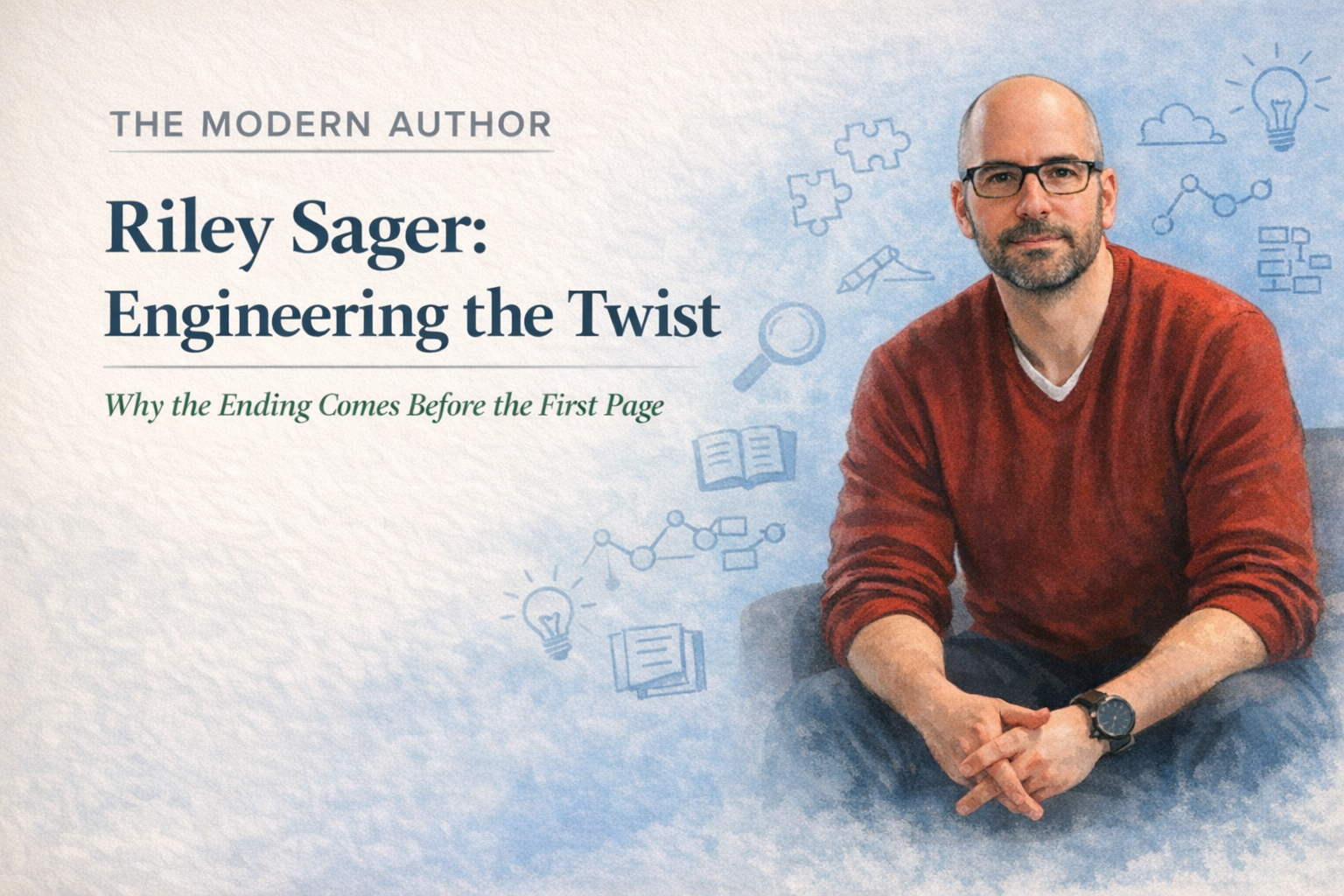
The Modern Author: Why Riley Sager Engineers His Endings Before He Writes Page One
Most thriller writers start with a premise.
A creepy house.
A missing person.
A suspicious spouse.
Riley Sager starts with the twist.
That difference explains his edge.
His advantage isn’t inspiration. It’s structure.
Riley Sager’s career shows that sustainable commercial fiction isn’t built on talent alone. It’s built on engineering: lock the ending first, outline when complexity demands it, use genre as shorthand with a fresh turn, and make career decisions based on the long game you actually want.
What looks like instinct is usually architecture.
Begin With the Twist
Most thriller writers start with a premise.
A house. A disappearance. A suspicion.
Sager starts with the ending.
The real shift is this: if the story depends on revelation, the revelation cannot be optional. It has to be known before the first chapter is written.
The twist is not something you discover halfway through.
It’s something you design toward.
Once the endgame is fixed, every scene has direction. Clues are intentional. Misdirection is controlled. Escalation is calibrated.
This is the difference between asking, “What happens next?” and asking, “What must be true for this ending to work?”
If the ending keeps moving, the structure never stabilizes.
Outlining Is Structural Insurance
Once the ending is set, coherence becomes the risk.
Thrillers are structurally fragile. Add multiple suspects, layered timelines, reversals, and secrets, and each moving part increases the cost of improvisation.
Sager outlines because complexity compounds.
If the plot is intricate, improvisation is expensive.
That doesn’t mean every book requires rigid architecture. Some stories can tolerate exploration. Simpler narratives can be drafted forward and shaped later.
The distinction is structural.
When complexity rises, freedom narrows.
Modern authors don’t outline as doctrine.
They outline when coherence is on the line.
Character Logic
Twist-first plotting creates a predictable danger.
Characters can become mechanisms.
Readers feel it immediately when a decision exists only to move the plot.
Sager’s lens is direct: start with what happened to them.
What shaped their fear?
What shaped their blind spots?
What shaped their need?
Plot decisions must follow from history.
If behavior doesn’t make psychological sense, the twist won’t feel earned. Readers won’t articulate it in structural terms. They’ll say something simpler: that doesn’t feel right.
Engineering a thriller doesn’t mean forcing behavior to serve structure.
It means aligning structure with psychology.
The Containment Test
Many thrillers rely on containment.
An isolated house. A remote island. An apartment with rules.
But containment is not atmosphere.
It’s constraint.
The test is blunt: why can’t they leave?
External constraints help, storms, contracts, physical isolation.
Internal constraints matter more, financial pressure, pride, guilt, attachment.
If the protagonist can walk away without consequence, tension evaporates.
If it can’t sustain pressure, it’s not a premise.
It’s a backdrop.
Containment only works when exit carries cost.
Tropes Are Compression
Genre is often treated as limitation.
Sager treats it as compression.
Tropes communicate instantly. A haunted house signals danger. An unreliable narrator signals instability. A final girl signals endurance.
Readers orient without explanation.
Modern authors don’t avoid conventions.
They leverage them.
The move is simple: use the familiar structure to accelerate immersion, then adjust it.
Shift the angle.
Complicate the expectation.
Add friction where readers expect smoothness.
This is the difference between imitation and iteration.
Genre becomes a speed lane, not a cage.
The Career Layer: Decide What You Want This to Be
Creative architecture reflects career architecture.
Do you want to be a full-time commercial author?
Do you want literary autonomy?
Do you want scale?
Each answer changes how you design.
If you want broad distribution, you must understand mainstream expectations. If you want niche depth, you accept narrower reach.
The mistake is drifting without choosing.
Modern authors don’t separate craft from career.
They define the game first.
Then they build accordingly.
Strategic Positioning Moves: Pen Names, Market Signals, and What Actually Changes the Game
Sager’s career includes decisions that reflect long-term thinking.
A pen name can function as a reset when past sales history becomes a negotiation constraint. It’s not reinvention for ego. It’s repositioning for leverage.
Certain validation signals shift perception disproportionately. A single high-trust endorsement can alter retailer confidence and distribution.
Other signals matter less than authors assume. Industry rituals create optics, not necessarily demand.
The real shift is understanding what changes leverage, and what only changes appearance.
Engineering applies beyond the manuscript.
The Engineering Rules
If the story depends on revelation, the ending must be fixed.
If the plot is complex, improvisation is expensive.
If behavior ignores history, the twist won’t land.
If the protagonist can leave, tension collapses.
If you use a trope without adjusting it, you’re borrowing familiarity without adding friction.
If you don’t define the career you want, the market will define it for you.
What This Means for Modern Authors
Riley Sager’s advantage isn’t mystical.
It’s structural.
Begin with the twist when the story depends on revelation.
Outline when complexity makes improvisation fragile.
Design characters from history, not convenience.
Pressure-test containment.
Use genre to accelerate orientation, then adjust it.
Define the career you want before you optimize for it.
Talent may start stories.
Structure sustains them.
If a book can’t survive engineering, it won’t survive scale.
Listen:
Watch:
About the Author
Eric Koester is an award-winning entrepreneurship professor at Georgetown University, bestselling author, and founder of Manuscripts. He has helped more than 3,000 nonfiction authors turn ideas into books, and books into platforms for speaking, media, and business growth.
About Manuscripts
Manuscripts is a modern publishing partner for nonfiction authors who want their books to drive real-world outcomes. We help founders, executives, coaches, and experts design, write, and launch books that build authority, attract opportunities, and compound into long-term business assets.
Work With Us
If you’re writing a book you want to matter, we’ll help you map the right strategy before you write another word.
Schedule a Modern Author Strategy Session





Leave a Reply