

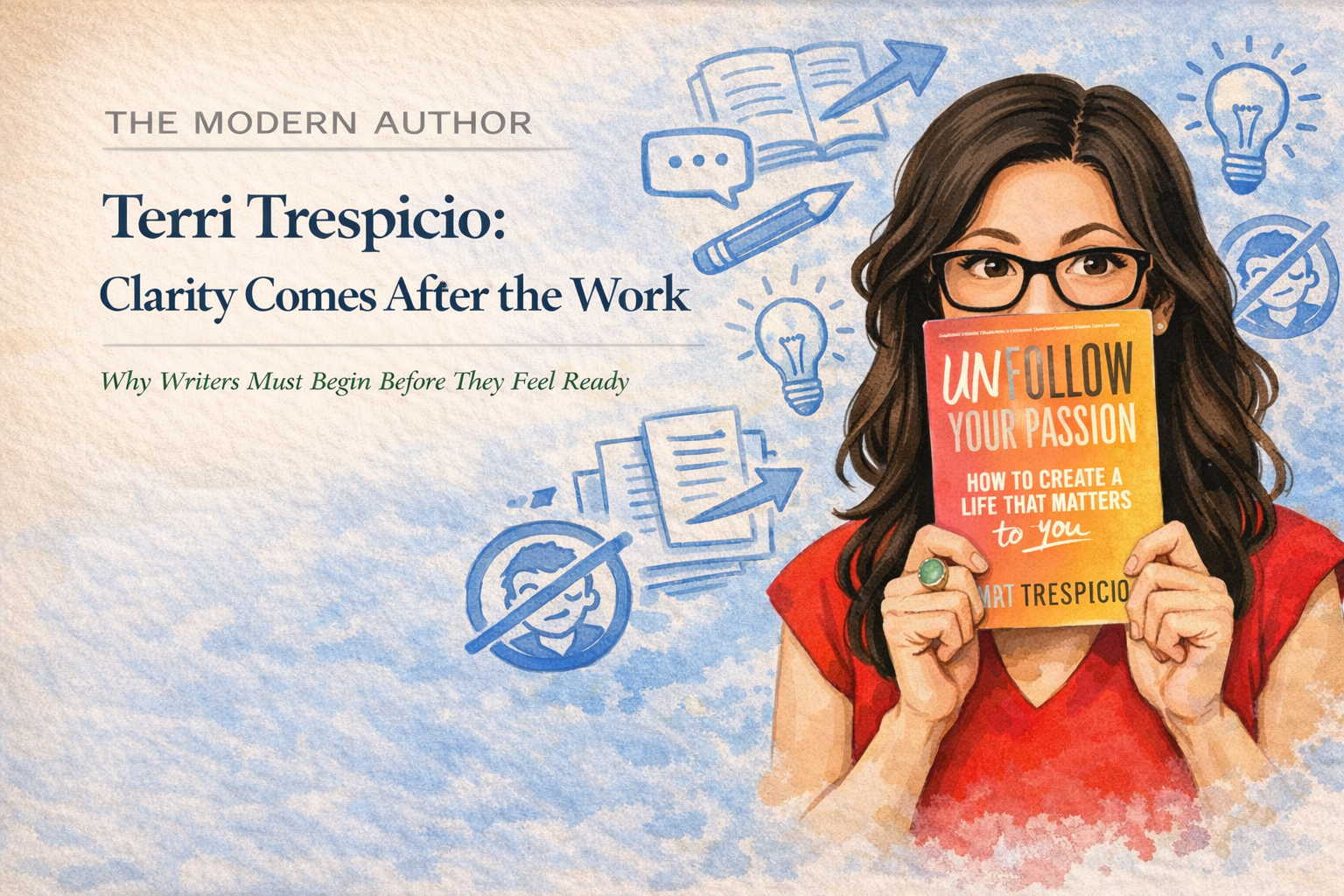
The Modern Author: Terri Trespicio on Writing Before Clarity Arrives
Most writers believe clarity must come before the work.
Terri Trespicio believes the opposite.
Clarity doesn’t arrive first. It arrives after you begin.
Her lesson is practical, not inspirational: say yes before you feel ready, let the work evolve under your hands, and treat the inner critic as a protective voice you can manage, not a guide you must obey.
Confidence does not precede progress.
Progress produces confidence.
Who This Is For
This is for you if:
- you keep waiting to “figure it out” before you draft
- your inner critic gets louder as the stakes rise
- you collect feedback but feel more confused afterward
- you rely on inspiration instead of structure
- you want momentum without waiting for certainty
The Modern Author Lesson
The real shift is simple:
Clarity is not a prerequisite for writing.
It is the result of writing.
Modern authors do not wait for confidence.
They create conditions where clarity is forced to emerge.
5 Moves Modern Authors Can Steal from Terri Trespicio
Say Yes Before You Feel Ready
Momentum rarely starts with certainty.
It starts with a yes.
A speaking opportunity. A draft deadline. A half-formed idea shared publicly.
Saying yes creates structure:
- Expectations
- Deadlines
- Feedback loops
Structure replaces hesitation.
Modern authors don’t wait until they feel prepared.
They commit first, and let commitment pull the work forward.
Progress precedes confidence.
Let the Work Reveal the Argument
Writers often assume they must understand their argument before they begin.
Terri’s inversion is cleaner: you discover the argument by drafting.
The first version rarely contains a polished thesis. It contains fragments, repeated tensions, recurring phrases, unresolved frustrations. Those repetitions are not noise. They are signal.
Drafting isn’t documentation. It’s excavation.
A practical sequence looks like this:
- Write the messy version without solving it.
- Notice what ideas repeat.
- Identify the tension underneath those repetitions.
- Shape that tension into a claim.
Clarity isn’t something you wait for.
It’s something you extract.
Modern authors let the draft do the thinking.
Treat the Critic as a Gatekeeper, Not a Guide
The inner critic often sounds authoritative.
It carries internalized voices, teachers, editors, authority figures, and presents itself as protection. Its job is to prevent embarrassment, vulnerability, and exposure.
But protection is not the same as guidance.
When the critic is mistaken for truth, it blocks access to creativity itself. You hesitate before you experiment. You revise before you explore. You edit before you understand.
The goal is not to eliminate the critic. That’s unrealistic.
The goal is to recognize its function, and proceed anyway.
Modern authors don’t silence the critic.
They stop obeying it.
Seek Trusted Counsel, Not Crowd Consensus
Early drafts are fragile.
Creative loneliness is real. The solution, however, is not broad feedback. It’s selective input.
Terri draws a clear distinction between camaraderie and consensus.
Write alongside others. Share space. Normalize the process.
But do not become a collector of opinions.
Use a simple filter:
- Would I actually take direction from this person?
- Do I trust their taste?
- Do they understand what I’m trying to build?
Consensus dilutes clarity.
Trusted counsel sharpens it.
Modern authors curate input instead of crowdsourcing identity.
Use Constraints to Outmaneuver Doubt
Inspiration follows action.
Not the other way around.
When stuck, Terri recommends shifting from abstract thinking to physical movement:
- Cut paragraphs
- Reorder sections
- Spread notes across a table
Time-box the work.
Add time constraints as well. Work in focused intervals. Stop before exhaustion. Return with perspective.
The rhythm matters:
Write fiercely.
Step away.
Return clearer.
And give yourself permission to draft badly.
A messy first version is not failure.
It is access.
Constraints create motion. Motion reduces doubt.
Modern authors don’t depend on mood.
They design structures that keep them moving when confidence is missing.
The Bottom Line
Clarity does not arrive before you begin.
It arrives because you begin.
Say yes before certainty.
Let drafting clarify your thinking.
Treat the critic as protection, not truth.
Seek trusted counsel.
Use constraints to keep moving.
Modern authors do not wait to feel ready.
They build readiness through action.
FAQs
Do writers really need clarity before drafting?
No. Drafting is how clarity forms.
What if the draft goes nowhere?
Then the draft has still shown you what doesn’t work.
That information is part of the process.
Listen:
Watch:
About the Author
Eric Koester is an award-winning entrepreneurship professor at Georgetown University, bestselling author, and founder of Manuscripts. He has helped more than 3,000 nonfiction authors turn ideas into books, and books into platforms for speaking, media, and business growth.
About Manuscripts
Manuscripts is a modern publishing partner for nonfiction authors who want their books to drive real-world outcomes. We help founders, executives, coaches, and experts design, write, and launch books that build authority, attract opportunities, and compound into long-term business assets.
Work With Us
If you’re writing a book you want to matter, we’ll help you map the right strategy before you write another word.
Schedule a Modern Author Strategy Session









Leave a Reply