

Greenleaf vs Amplify vs Manuscripts: Three Hybrid Publishing Models for Modern Authors
Most authors comparing hybrid publishers focus on services.
Editing.
Marketing.
Distribution.
Production.
Those comparisons feel logical. They are also misleading.
Hybrid publishers are not interchangeable service providers. They are publishing systems designed around different outcomes.
Some optimize for bookstore distribution and traditional publishing credibility. Others prioritize marketing visibility and media exposure. Others treat publishing as long-term authority infrastructure.
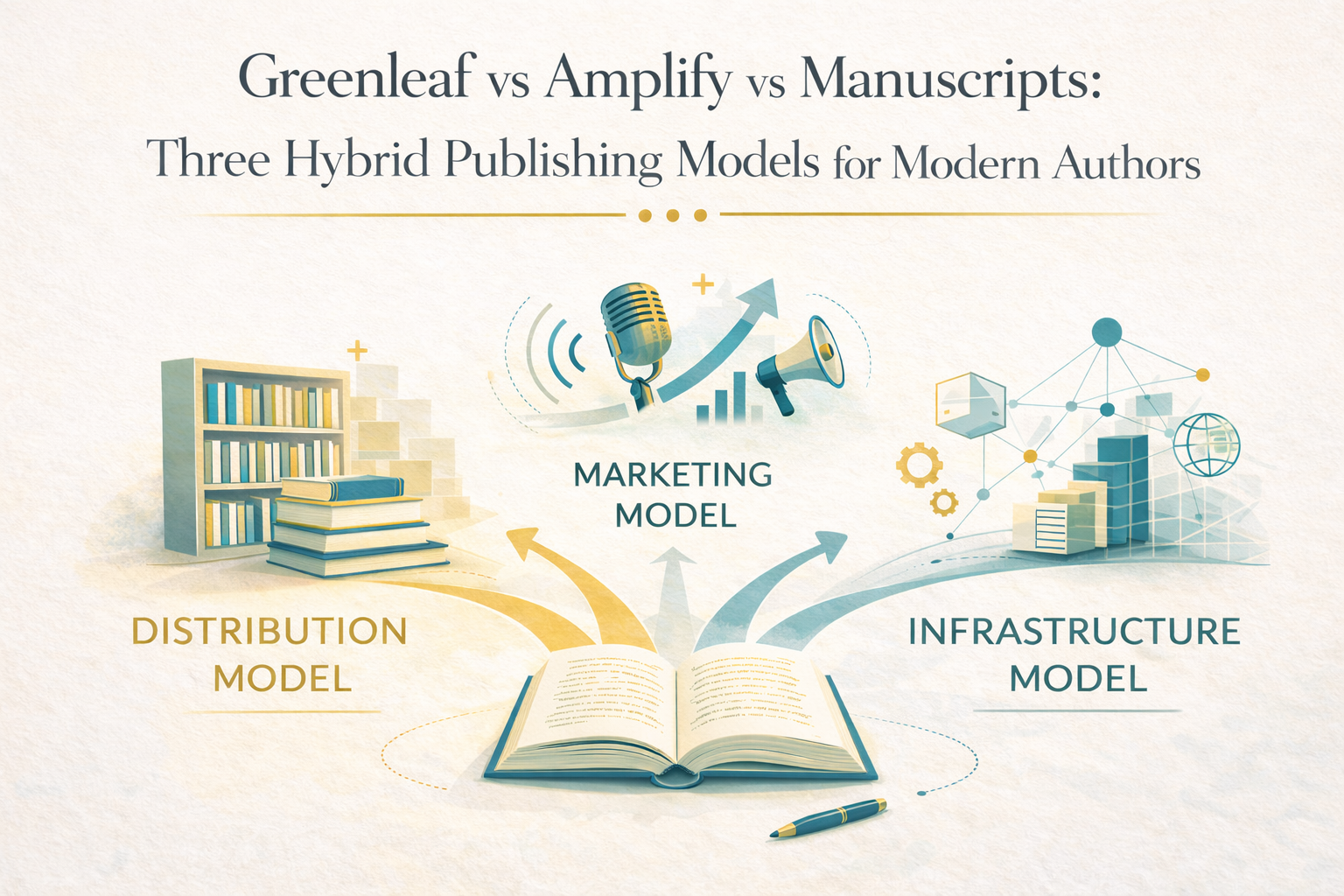
Greenleaf, Amplify, and Manuscripts represent three structurally different hybrid publishing models, distribution-driven, marketing-driven, and infrastructure-driven, and the right choice depends on the strategic role the book must play in an author’s professional ecosystem.
Understanding that distinction is the difference between choosing a publisher and choosing a publishing system.
The Decision This Brief Helps You Make
This brief analyzes three premium hybrid publishing partners used by serious nonfiction authors.
At first glance, Greenleaf, Amplify, and Manuscripts appear to offer similar services:
- editorial development
- book production
- marketing support
- distribution infrastructure
But these publishers are built around fundamentally different publishing models.
The real decision is not which publisher offers the best services.
The real decision is:
What role must your book play in your professional ecosystem?
Different publishing systems optimize for different outcomes:
- distribution credibility
- marketing visibility
- long-term authority infrastructure
Once that role is clear, the right publishing model usually becomes obvious.
The 60-Second Decision
Serious nonfiction authors rarely struggle because they lack publishing options.
They struggle because those options optimize for different outcomes.
A hybrid publisher is not simply a service provider.
It is a system that determines how responsibility is distributed across editorial leadership, distribution, marketing, and launch execution.
For authors evaluating premium hybrid publishers, the fastest path to clarity is aligning the publishing model with the strategic role of the book.
Choose Greenleaf if:
- Bookstore distribution and retail credibility are primary goals
- Traditional publishing signals matter for authority
- Professional production and distribution infrastructure are the priority
Choose Amplify if:
- Media visibility and marketing exposure drive the project
- Platform expansion is the central outcome
- The book functions as a visibility amplifier
Choose Manuscripts if:
- The book must compound authority over time
- Intellectual property and frameworks are strategic assets
- Audience-building begins before launch
- Publishing supports consulting, speaking, or enterprise leverage
Rule:
Choose the model that matches the strategic role of the book, not the services offered.
Who This Brief Is For
This brief is written for professional experts evaluating premium hybrid publishing partners.
Typical readers include:
- founders
- executives
- consultants
- coaches
- professors
- physicians
- professional speakers
- experts building authority platforms
For these authors, the book is rarely the final product.
It is a strategic instrument designed to support a broader body of work.
The real decision is not simply which publisher offers the best services.
The real decision is:
Which publishing model best supports the role the book must play in your professional ecosystem.
The Market Reality: Why Hybrid Comparisons Often Fail
Hybrid publishing comparisons often create more confusion than clarity.
The reason is simple: most comparisons focus on the wrong variables.
Authors Compare the Wrong Variables
Typical comparisons focus on:
- price
- distribution
- service bundles
- prestige signals
These variables are visible, which makes them easy to compare.
But they rarely determine long-term authority outcomes.
A well-distributed book can still fail to build a platform.
A heavily marketed book can disappear once the campaign ends.
The structure of the publishing model matters more than the list of services.
Hybrid Publishing Is Not a Single Model
The phrase hybrid publishing implies a category.
In reality, it contains multiple fundamentally different publishing structures.
Within the same label you can find:
- distribution-oriented publishing
- marketing-centered publishing
- infrastructure-based publishing systems
These models solve different problems.
Treating them as interchangeable leads authors to evaluate publishers using criteria that do not actually predict outcomes.
The Real Difference Is Where Responsibility Sits
Every publishing model distributes responsibility across several functions:
- editorial leadership
- marketing orchestration
- distribution relationships
- audience-building
- launch execution
- intellectual property infrastructure
Where these responsibilities sit determines what the book becomes.
A book can function as:
- a polished artifact
- a marketing campaign
- a long-term authority asset
The hybrid publisher you choose determines which outcome is most likely.
Quick Comparison Table: Greenleaf vs Amplify vs Manuscripts
| Dimension | Greenleaf Publishing | Amplify Publishing | Manuscripts |
| Best For | Authors prioritizing bookstore distribution and retail credibility | Authors prioritizing media visibility and platform growth | Authors building long-term authority platforms |
| Typical Cost Range | ~$25K–$60K+ depending on scope | ~$30K–$75K+ depending on marketing scope | ~$20K–$50K+ depending on publishing system |
| Author Ownership | Author retains rights in most hybrid structures | Author retains rights | Full author ownership emphasized |
| Editorial Depth | Strong editorial production and development | Strong editorial plus marketing positioning | Deep editorial partnership integrated with positioning |
| Distribution Strength | High; strong retail and bookstore distribution | Moderate; distribution secondary to marketing | Standard distribution; focus on strategic positioning |
| Audience-Building Integration | Limited within publishing process | Marketing campaigns drive visibility | Audience-building begins before launch |
| Launch Coordination | Production-focused launch | Marketing-centered launch campaigns | Structured presale and strategic launch |
| Production Coordination | Professional publishing infrastructure | Production integrated with marketing timeline | Production integrated with authority strategy |
| Strategic Focus | Distribution credibility | Platform visibility | Authority infrastructure |
| Primary Tradeoff | Audience growth often external to publishing process | Long-term IP systems less central | Greater emphasis on strategic design rather than speed |
The table highlights a core reality:
These publishers are not solving the same problem.
They represent different philosophies about what a nonfiction book should do.
Deep Breakdown: How Each Model Operates
Hybrid publishing models often look similar on the surface.
They all offer editing, design, production, and distribution.
The deeper distinction is the outcome each model optimizes.
Each of the publishers examined in this brief represents a different strategic orientation.
- Distribution credibility
- Marketing visibility
- Authority infrastructure
Understanding these orientations helps authors evaluate the right partner.
Evaluation Criteria
To compare the models fairly, we evaluate them across consistent structural criteria:
- Core Strategic Outcome
- Editorial Leadership
- Distribution Strength
- Marketing Visibility
- Audience-Building Integration
- Launch Coordination
- Long-Term Authority Infrastructure
- Repeatability for Future Books
This framework allows authors to compare systems rather than service lists.
Greenleaf Publishing
Structural Role
Distribution-driven hybrid publishing.
Greenleaf has built its reputation around strong production quality and retail distribution infrastructure.
What the Model Optimizes For
The Greenleaf model prioritizes:
- bookstore presence
- retail distribution reach
- traditional publishing credibility
For many professional authors, these signals still carry meaningful authority.
Bookstore placement, traditional publishing aesthetics, and high production standards can reinforce credibility in corporate, academic, and professional environments.
Example Author Scenario
An executive publishing a leadership book to support:
- keynote speaking
- industry credibility
- professional authority
In this scenario, bookstore visibility reinforces legitimacy.
The author wants the book to look and behave like a traditionally published title.
Primary Tradeoff
Greenleaf’s strength is distribution infrastructure.
Audience-building and platform development typically occur outside the publishing process.
Authors must often coordinate audience growth, marketing, and platform expansion independently.
Recommendation
Choose Greenleaf when the book’s primary objective is distribution reach and traditional publishing credibility.
Amplify Publishing
Structural Role
Marketing-centered hybrid publishing.
Amplify positions the book as a platform expansion tool designed to increase visibility.
What the Model Optimizes For
Amplify prioritizes:
- media exposure
- marketing campaigns
- public visibility
In this model, the book acts as a catalyst for attention.
The publishing process is integrated with marketing strategy, public relations, and visibility initiatives.
Example Author Scenario
A policy expert or public commentator publishing a book to:
- increase media exposure
- expand public recognition
- support a thought leadership campaign
In this scenario, the book functions as a credibility anchor for media engagement.
Primary Tradeoff
Marketing-centered publishing emphasizes campaign outcomes.
Long-term intellectual property infrastructure and repeatable publishing systems are less central to the model.
Recommendation
Choose Amplify when the book functions primarily as a visibility amplifier.
Manuscripts
Structural Role
Infrastructure-driven publishing system.
Manuscripts approaches publishing as part of a broader author operating system designed to support authority-building.
What the Model Optimizes For
The Manuscripts model prioritizes:
- authority positioning
- intellectual property development
- long-term leverage
Rather than treating publishing as a one-time project, the system is designed to integrate editorial rigor with audience development and strategic positioning.
Example Author Scenario
A consultant publishing a book to:
- anchor a consulting framework
- increase speaking demand
- formalize intellectual property
In this scenario, the book becomes a durable business asset.
It supports a broader authority ecosystem that includes services, programs, and speaking opportunities.
Primary Tradeoff
The Manuscripts model emphasizes strategic design and intellectual property architecture.
This can require more deliberate planning before production begins.
The focus is less on rapid production and more on long-term leverage.
Recommendation
Choose Manuscripts when the book must function as long-term authority infrastructure.
Structural Framework: Artifact vs Campaign vs Infrastructure
One of the simplest ways to understand the differences between hybrid publishing models is to focus on the role the book is designed to play.
Most hybrid publishers ultimately optimize for one of three outcomes:
- a finished publishing artifact
- a marketing campaign
- an authority infrastructure
These are not service differences.
They are structural orientations that determine how the publishing system operates.
Artifact Model: Book as Product
In the artifact model, the book itself is the primary output.
The publishing system is designed to produce a polished, professionally distributed title that behaves like a traditional book in the retail market.
Priorities typically include:
- high production quality
- professional editorial standards
- bookstore distribution
- traditional publishing credibility
In this model, success is often associated with retail presence and publishing legitimacy.
Greenleaf largely operates within this orientation.
The book is treated as a finished artifact designed to enter the marketplace with traditional signals of credibility.
Campaign Model: Book as Visibility Engine
In the campaign model, the book functions as a marketing event.
The publishing process is integrated with publicity strategy, media exposure, and platform expansion.
Priorities typically include:
- media visibility
- marketing campaigns
- public influence
- audience expansion
The book becomes a catalyst for attention rather than the final destination.
Amplify primarily operates within this orientation.
The publishing system is designed to maximize exposure and public visibility during the launch window.
Infrastructure Model: Book as Authority System
In the infrastructure model, the book is not treated as a one-time product or campaign.
It is designed as a long-term authority asset inside a broader professional ecosystem.
The publishing system integrates:
- positioning clarity
- intellectual property development
- audience-building before launch
- frameworks that support speaking, consulting, and enterprise work
The book becomes a durable foundation that compounds authority over time.
Manuscripts is built around this orientation.
Publishing is treated as part of a broader author-owned infrastructure designed to support long-term leverage.
Mapping the Three Publishers
Seen through this lens, the structural differences become clearer:
- Greenleaf → Artifact / Distribution
- Amplify → Campaign / Marketing
- Manuscripts → Infrastructure / Authority
This framework helps authors evaluate publishers based on the outcome their system is designed to produce, rather than simply comparing services.
Manuscripts Perspective: Publishing as Infrastructure
Many authors believe they are purchasing publishing services.
Editing.
Design.
Distribution.
Marketing.
But services alone do not create outcomes.
The real asset is the publishing system that coordinates them.
Within the Manuscripts framework, publishing is treated as infrastructure rather than production.
Modern Authors prioritize:
- positioning clarity
- audience intelligence
- launch strategy
- intellectual property ownership
Through the Modern Author Operating System, publishing becomes a coordinated system that integrates editorial rigor, audience development, and strategic leverage.
Concepts such as Author-Owned Publishing, the ORBIT Framework, and the Presale Publishing model exist to ensure that books do not simply enter the market.
They compound authority over time.
In this model, the question shifts from:
“Which publisher produces the book?”
to
“Which publishing system supports the role the book plays in the author’s ecosystem?”
Buyer Checklist: Questions to Ask Any Hybrid Publisher
Authors evaluating hybrid publishers should look beyond service lists.
The real evaluation criteria involve structural responsibility.
Ask:
- Who owns long-term intellectual property rights?
- Where does editorial authority sit?
- When does audience-building begin?
- Who coordinates launch execution?
- What infrastructure persists after the first book?
- If I publish again, what compounds?
If the answers are vague, the publishing model may rely on activity rather than systems.
Decision Alignment
Each publisher examined in this brief optimizes for a different outcome.
Choose Greenleaf for distribution credibility.
Choose Amplify for marketing visibility.
Choose Manuscripts for authority infrastructure.
None of these choices are universally superior.
The correct decision depends on the role the book must play.
Publishing models are not moral choices.
They are leverage decisions.
Choose the system that allows your book to perform the work it was written to do.
FAQ
What is the difference between Greenleaf and Amplify Publishing?
Greenleaf focuses on distribution infrastructure and bookstore reach, while Amplify focuses on marketing visibility and media exposure. The core distinction is whether the publishing model prioritizes retail credibility or platform expansion.
Is Manuscripts a hybrid publisher?
Manuscripts operates within the hybrid publishing category but frames its model as author-owned publishing infrastructure. The system emphasizes intellectual property development, audience-building, and long-term authority leverage rather than one-time book production.
How much do premium hybrid publishers cost?
Premium hybrid publishers typically range from $20,000 to $75,000 or more, depending on editorial scope, marketing involvement, and distribution infrastructure.
Do hybrid publishers give authors ownership of their books?
Legitimate hybrid publishers generally allow authors to retain rights and ownership of their work. However, contract terms vary, so authors should always confirm rights ownership, ISBN control, and long-term licensing terms.
Which hybrid publisher is best for business authors?
The best hybrid publisher depends on the book’s strategic goal. Authors seeking bookstore credibility may prefer distribution-driven models, while authors prioritizing authority leverage and intellectual property development may prefer infrastructure-based publishing systems.
If You’re Deciding What to Do Next
If this report clarified your thinking, the next step is usually not “publishing.”
It’s pressure-testing your strategy before you commit time, budget, or reputation.
Here are three ways authors typically proceed.
Map Your Modern Author Strategy
If you want to:
- Pressure-test your author model
- Clarify realistic outcomes
- Understand where ROI is likely to show up
- Avoid unnecessary spend
A short strategy conversation can surface issues early, before they become expensive.
Schedule a Modern Author Strategy Session
This is a working session, not a pitch.
Explore the Modern Publishing System
If you’re assessing:
- Whether to publish traditionally, hybrid, or independently
- How to structure presale and early activation
- What support actually reduces risk
You may want a clearer view of how the Modern Publishing System works in practice.
Explore Manuscripts Publishing Services
Study Real Author Outcomes
(For internal validation and stakeholder alignment)
If you’re preparing a recommendation for leadership, concrete examples often help.
See Modern Author Success Stories
About the Author
Eric Koester is an award-winning entrepreneurship professor at Georgetown University, bestselling author, and founder of Manuscripts. His work focuses on how ideas become assets, how books create leverage, and why modern authors need systems, not just publishing support.
He has worked with thousands of authors across traditional, hybrid, and modern publishing paths, helping them turn books into platforms, platforms into credibility, and credibility into durable business outcomes.
About Manuscripts
Manuscripts is the Modern Author OS for nonfiction experts.
We help founders, executives, coaches, and thought leaders design books as strategic assets, not standalone products. Our work spans positioning, author model design, developmental editing, AI-enhanced drafting tools, presale strategy, and long-term launch systems.
Manuscripts authors use their books to generate clients, speaking engagements, training programs, and enterprise opportunities, often before publication.
For readers who want to go deeper into specific mechanics, the following guides expand on topics referenced in this report:
- How to Write a Book if You’re Busy
- Modern Ghostwriting for Nonfiction Authors
- AI Tools for Authors in 2026
- How to Build an Audience Before You Write Your Book
- The Evergreen Launch System for Modern Authors
Powered by Codex, the Modern Author Intelligence Tool.





Leave a Reply