

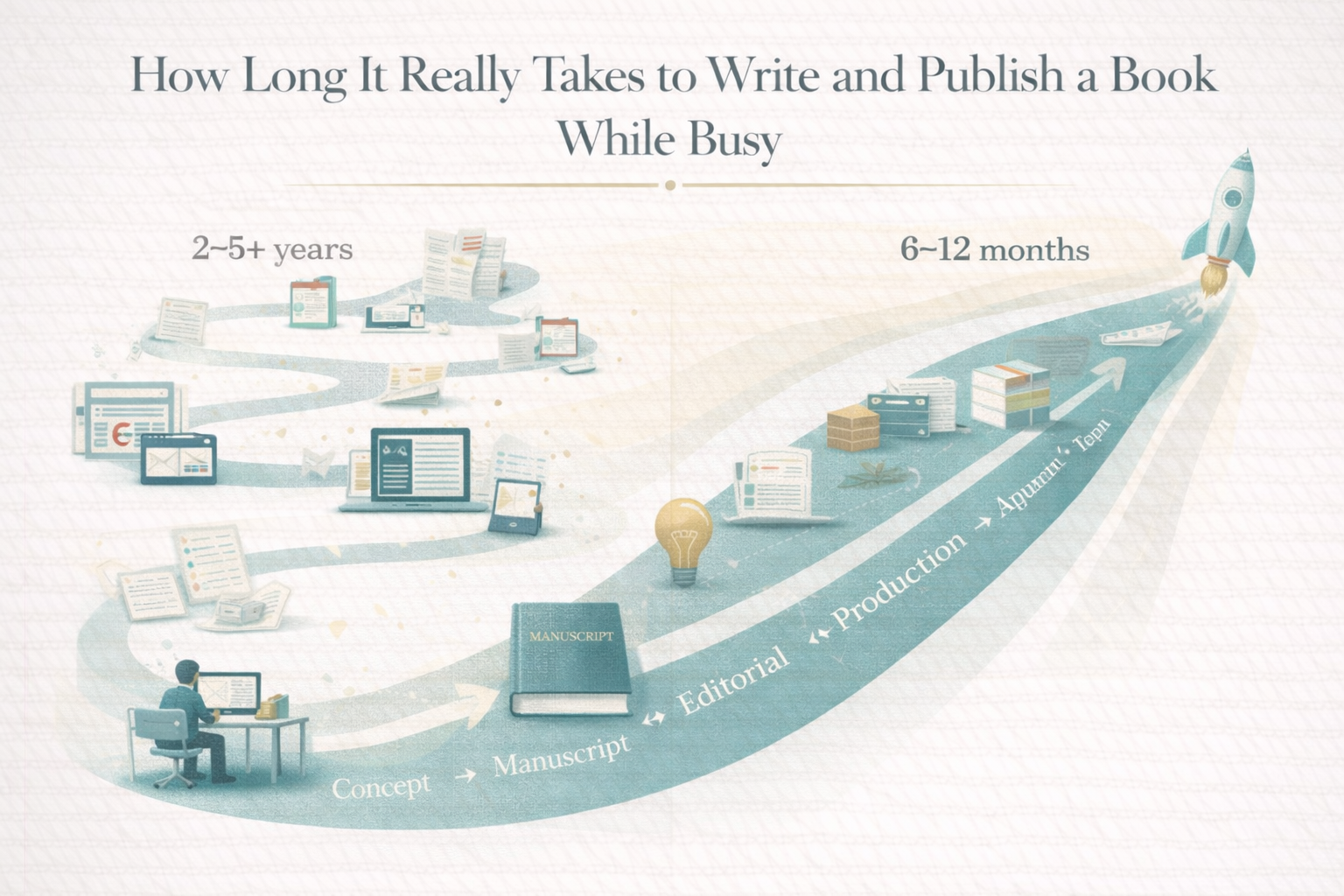
How Long It Really Takes to Write and Publish a Book While Busy
Most professionals assume books take years because writing a manuscript is slow.
That assumption is understandable. Writing a book alongside running a company, managing a practice, or leading a team feels like a massive time commitment.
But writing speed is rarely what determines how long a book actually takes.
What determines the timeline is how the execution behind the book is coordinated.
Publishing a serious nonfiction book involves multiple stages: concept development, manuscript drafting, editorial development, production, and launch preparation. When these stages are loosely coordinated, or managed entirely by the author between other responsibilities, projects often stretch for years.
When the same work is coordinated through a structured publishing system, timelines compress dramatically.
For busy professionals, the real decision is not simply how fast they can write.
It is which publishing pathway provides the execution system that will move the book from idea to publication within a realistic timeline.
The 60-Second Decision
Professionals evaluating book timelines often want a simple answer: How long will this realistically take?
The answer depends primarily on how the publishing process is coordinated.
Typical outcomes look like this:
Self-managed writing while busy
→ books frequently take 2–5+ years, and many never reach publication.
Traditional publishing path
→ typically 18–36 months, largely due to institutional production and release schedules.
Hybrid publishing path
→ often 9–18 months, depending on how editorial development and production are coordinated.
Author-owned publishing systems with integrated execution
→ often 6–12 months, when editorial leadership, production, and launch preparation operate within one coordinated system.
The central insight is straightforward:
Publishing timelines depend primarily on execution coordination, not how quickly an author writes.
Who This Brief Is For
This brief is written for professionals evaluating how long a serious nonfiction book will take to complete and publish.
Typical readers include:
- founders and entrepreneurs
- CEOs and executives
- consultants and advisors
- professional speakers
- subject-matter experts writing authority books
These authors share several common characteristics:
- limited writing time
- demanding professional schedules
- the intention to use a book to support authority, intellectual property, or business growth
For these professionals, the book is rarely a personal writing project.
It is a strategic asset intended to support their broader work.
Understanding publishing timelines therefore becomes a question of execution structure, not simply writing discipline.
Why Most Books Take Years
Books often take years to finish not because writing is unusually slow, but because the publishing process requires coordination across several stages.
When that coordination is weak, timelines expand.
Writing Is Only One Stage of the Process
Publishing a serious nonfiction book involves several stages beyond drafting chapters.
These typically include:
- concept development
- manuscript drafting
- editorial revision
- production
- launch preparation
Evidence claim:
Most delays occur between these stages, when decisions and contributors must be coordinated.
Why it matters:
Authors who plan only for writing time often underestimate the full timeline required for publication.
Independent Authors Often Lack Execution Infrastructure
Professionals managing their book independently usually coordinate the entire process themselves.
This includes managing:
- editors
- designers
- production vendors
- distribution setup
- launch preparation
Evidence claim:
Without a centralized execution system, each stage of publishing requires the author to initiate and coordinate the next step.
Why it matters:
Projects frequently stall between stages when authors must manage unfamiliar publishing tasks alongside their existing responsibilities.
Most Timeline Delays Occur During Stage Transitions
The largest slowdowns typically occur during transitions such as:
- manuscript to developmental editing
- editing to production
- production to launch preparation
Evidence claim:
Each transition requires coordination across contributors, schedules, and decisions.
Why it matters:
Publishing systems that manage these transitions efficiently shorten the overall timeline.
Quick Comparison Table: Typical Publishing Timelines
| Publishing Model | Typical Timeline | Who Manages Execution | Coordination Burden | Primary Timeline Risk |
| Self-Managed Publishing | 2–5+ years | Author | Very high | Fragmented coordination |
| Traditional Publishing | 18–36 months | Publisher | Low for author | Institutional publishing schedules |
| Hybrid Publishing | 9–18 months | Hybrid publisher + author | Moderate | Variation in execution quality |
| Author-Owned Publishing Systems | 6–12 months | Integrated publishing system | Moderate | Author engagement during the process |
The structural difference across these models is execution coordination.
This is the core variable explained in the framework below.
Signature Framework: The Timeline Compression Map
Publishing timelines compress as execution coordination increases.
This relationship is captured in the Timeline Compression Map, which explains why similar books can take dramatically different amounts of time to reach publication.
Horizontal Axis — Execution Coordination
Low coordination
→ the author manages writing, editing, production, and launch independently.
High coordination
→ a centralized publishing system manages transitions between stages.
Vertical Axis — Timeline Length
Long timelines
→ projects extend across multiple years.
Short timelines
→ projects move from concept to publication within months.
Placement across the framework:
- Self-managed publishing
Low coordination / longest timelines - Traditional publishing
Moderate coordination / institutionally paced timelines - Hybrid publishing
Higher coordination / shorter timelines - Author-owned publishing systems
Highest coordination / compressed timelines
The key takeaway from the Timeline Compression Map:
Publishing timelines shorten as execution coordination increases.
The Publishing Timeline Stack
Authors often underestimate publishing timelines because they focus only on writing.
In practice, publishing requires coordinating several layers of work.
Layer 1 — Concept and Positioning
This stage defines:
- the book’s thesis
- the intended audience
- the conceptual framework
Clear positioning accelerates all subsequent stages.
Layer 2 — Manuscript Development
This stage involves drafting the manuscript.
Busy professionals often write during limited time windows while balancing other commitments.
Layer 3 — Editorial Development
Editors strengthen the manuscript’s:
- structure
- argument clarity
- chapter progression
Developmental editing frequently reshapes portions of the book.
Layer 4 — Production and Publishing
Production includes:
- copyediting
- cover design
- interior layout
- distribution setup
These steps require coordination across specialized contributors.
Layer 5 — Launch Preparation
Preparing the book for release involves:
- audience communication
- messaging alignment
- launch coordination
When these layers are poorly coordinated, the overall timeline expands.
How Each Publishing Pathway Affects Timeline
Different publishing pathways coordinate the publishing process in different ways.
This coordination structure determines how quickly a book moves from idea to publication.
As introduced in the Timeline Compression Map, timelines compress as execution coordination increases. When coordination is fragmented, projects slow down between stages. When coordination is centralized, transitions between stages happen more quickly.
The following breakdown explains how each publishing pathway manages that coordination, and why their timelines differ.
Self-Publishing Alone
In a fully self-managed publishing process, the author functions as the central coordinator of the entire project.
This means managing multiple contributors, including editors, designers, formatting specialists, and distribution vendors. The author must also make key decisions about positioning, editorial structure, production schedules, and launch preparation.
Because each stage depends on the author initiating the next step, progress frequently pauses between stages while decisions are made and contributors are sourced.
For busy professionals balancing publishing alongside other responsibilities, this coordination burden often extends the timeline significantly.
Typical timeline:
1–3+ years.
Strengths
Self-publishing offers maximum control over the publishing process, allowing the author to select vendors and determine the pace of work.
Tradeoffs
Without centralized coordination, progress often slows during transitions between writing, editing, production, and launch preparation.
Primary timeline risk
Fragmented execution across multiple vendors and stages.
Traditional Publishing
Traditional publishing transfers much of the production coordination to the publisher.
The publisher manages editorial development, design, production, and distribution infrastructure. However, traditional publishers operate on institutional production calendars that are designed around seasonal release schedules and internal planning cycles.
As a result, even after the manuscript is complete, books often wait months before entering the production queue.
While the author benefits from an established publishing infrastructure, the institutional nature of traditional publishing typically extends the timeline.
Typical timeline:
18–36 months.
Strengths
Traditional publishers provide established editorial teams, production systems, and retail distribution channels.
Tradeoffs
Institutional publishing schedules introduce delays that are largely outside the author’s control.
Primary timeline risk
Extended timelines due to fixed publishing calendars and internal production queues.
Hybrid Publishing
Hybrid publishing combines professional publishing infrastructure with author ownership of the intellectual property.
In this model, the publisher typically coordinates editorial development, production, and some elements of launch preparation. Because hybrid publishers are not constrained by traditional publishing calendars, timelines are generally shorter.
However, hybrid publishing providers vary widely in how thoroughly they coordinate the full publishing process. Some focus primarily on production services while leaving positioning, audience-building, and launch planning largely to the author.
As a result, timelines may vary depending on how integrated the publisher’s execution system is.
Typical timeline:
9–18 months.
Strengths
Hybrid publishing often moves faster than traditional publishing while still providing professional editorial and production support.
Tradeoffs
Execution quality and strategic depth vary significantly across providers.
Primary timeline risk
Variation in how well the publisher coordinates editorial, production, and launch stages.
Author-Owned Publishing Systems
Author-owned publishing systems are designed to coordinate the entire publishing process around the author’s timeline and goals.
In this model, editorial leadership, manuscript development, production coordination, and launch preparation operate within a single integrated system. This structure reduces the delays that typically occur between publishing stages.
Because the system manages transitions between concept development, writing, editing, and production, books can move from idea to publication more quickly while still maintaining editorial rigor.
The author remains deeply involved in the intellectual development of the book, but the operational coordination of the publishing process is centralized.
Typical timeline:
6–12 months.
Strengths
Centralized coordination across the publishing process allows projects to move efficiently from manuscript development to publication.
Tradeoffs
The process still requires consistent author engagement during manuscript development.
Primary timeline risk
Projects may slow if the author becomes unavailable during key development stages.
Hidden Timeline Delays Most Authors Don’t Anticipate
Even when authors understand the stages of publishing, timelines often expand because of delays that occur between those stages.
These delays rarely appear in early planning conversations, yet they are responsible for many of the multi-year publishing timelines professionals experience.
In most cases, the issue is not the writing itself.
It is the coordination of the work surrounding the manuscript.
Several common execution gaps quietly extend publishing timelines.
Unclear Book Positioning
Many projects begin before the book’s central idea is fully defined.
Authors may have strong expertise but lack clarity around:
- the core thesis
- the reader the book is written for
- the framework that organizes the ideas
When positioning is unclear, writing slows and editors must resolve structural questions later in the process. This frequently leads to additional revision cycles and significant timeline expansion.
Early positioning clarity is one of the most reliable predictors of a faster publishing timeline.
Repeated Editorial Revision Cycles
Developmental editing is a normal part of producing a serious nonfiction book.
However, timelines expand when structural issues are discovered late in the process.
For example:
- chapters may require reorganization
- arguments may need reframing
- entire sections may need rewriting
Each additional revision cycle introduces new rounds of review, editing, and approval.
When editorial architecture is defined early, these cycles tend to be shorter and fewer.
Vendor Coordination Gaps
Independent authors often assemble publishing teams from multiple freelancers.
While this approach offers flexibility, it introduces coordination risk.
Editors, designers, formatters, and production vendors typically operate on separate schedules. When transitions between these contributors are not actively coordinated, projects frequently stall between stages.
These pauses may last weeks or months depending on contributor availability.
Execution systems that centralize vendor coordination reduce these gaps.
Delayed Launch Preparation
Many authors begin thinking about launch only after the manuscript is complete.
This creates a final-stage bottleneck where:
- messaging must be developed
- launch materials must be prepared
- audience outreach must begin
When launch preparation starts late, publication timing often shifts to accommodate marketing preparation.
Integrating launch planning earlier in the publishing process helps prevent this delay.
The Pattern Behind Most Timeline Delays
Across these examples, the pattern is consistent.
Publishing timelines rarely expand because authors write slowly.
They expand because execution across stages is poorly coordinated.
Recognizing these risks allows authors to evaluate publishing systems not just by services offered, but by how effectively those systems manage the transitions between stages.
Manuscripts Perspective: Publishing Speed Is a Systems Problem
Many authors approach publishing as a writing challenge.
For Modern Authors, publishing speed is primarily a systems problem.
Producing a serious nonfiction book requires coordinating several disciplines:
- concept positioning
- manuscript development
- editorial revision
- production
- launch preparation
When these stages operate independently, delays accumulate during transitions.
When they operate inside a coordinated system, timelines compress.
This is why the Modern Author Operating System treats publishing as an integrated execution discipline rather than a solitary writing effort.
The goal is not only to finish a manuscript.
It is to coordinate the entire publishing process so ideas move efficiently from concept to publication.
Buyer Evaluation Checklist
Authors evaluating publishing pathways should ask:
- Who coordinates the publishing process from concept through launch?
- How are editing stages structured and scheduled?
- How early is launch preparation integrated into the timeline?
- Who manages vendor coordination and production logistics?
- What realistic timeline does this publishing model support?
Clear answers to these questions indicate whether a publishing pathway provides real execution infrastructure.
Decision Alignment
Different publishing priorities align with different execution models.
When speed is the primary priority
Author-owned publishing systems with integrated execution often provide the shortest timeline.
When distribution prestige is the priority
Traditional publishing offers institutional distribution but usually involves longer production timelines.
When professional production with retained ownership is the priority
Hybrid publishing provides editorial and production support while allowing authors to retain rights.
The right pathway depends on the role the book plays within the author’s broader professional strategy.
Rule of Thumb
Publishing timelines expand when execution is fragmented.
Publishing timelines compress when execution is coordinated.
Choosing the right publishing pathway is therefore less about writing speed and more about which system will coordinate the work required to bring the book to market.
FAQ
How long does it take to publish a book while working full-time?
Publishing timelines typically range from 6–12 months in coordinated publishing systems to 2–5+ years when the process is managed independently.
Why do many books take years to finish?
Most long timelines occur when publishing stages, writing, editing, production, and launch, are not coordinated through a structured execution system.
What publishing model is fastest for busy professionals?
Publishing systems with integrated editorial leadership and production coordination often produce the fastest timelines.
Does hybrid publishing speed up book timelines?
Yes. Hybrid publishing usually shortens timelines compared with traditional publishing because authors are not bound by institutional publishing schedules.
Can a busy professional finish a book in under a year?
Yes. With clear positioning and coordinated execution infrastructure, many professionals complete and publish books within 6–12 months.









Leave a Reply