

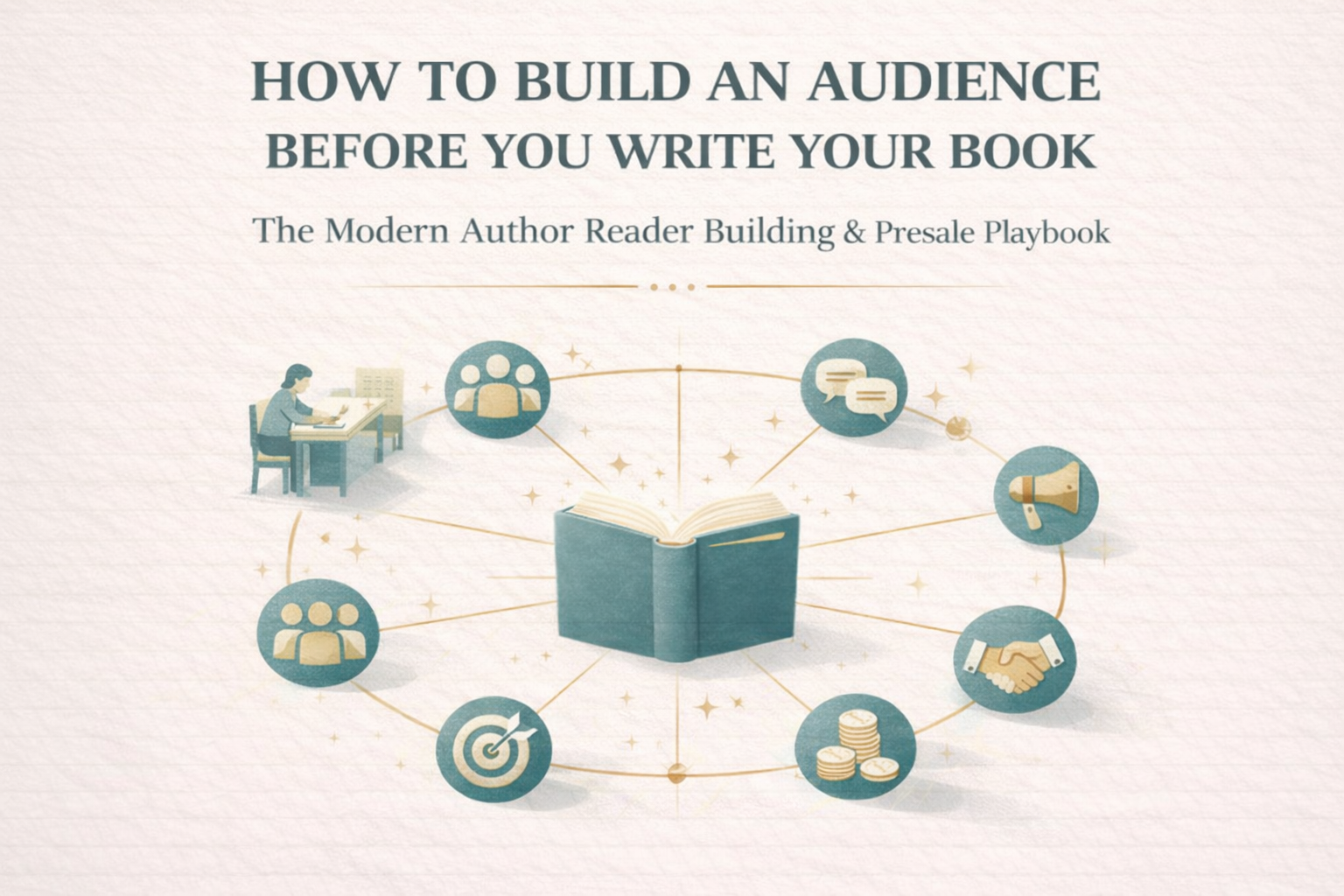
How to Build an Audience Before You Write Your Book
The Modern Author Reader-Building + Presale Playbook (2026 Edition)
Serious nonfiction books succeed when the audience is built before the manuscript is finished.
Most authors still believe the sequence looks like this:
Write the book.
Publish it.
Then market it.
That’s the old model.
And it’s why so many books disappear quietly the week they launch.
The Modern Author sequence is different:
Build the audience first.
Activate early readers.
Presell the book.
Then finish writing with momentum already behind you.
This isn’t a marketing trick.
It’s a structural shift in how serious nonfiction books get written, launched, and turned into lasting business assets.
Because the truth is simple:
Books don’t spread automatically, even great ones.
The world is full of smart, thoughtful, well-written books that never reach the people they were meant to reach, not because the ideas weren’t good, but because the author waited too long to bring anyone into the process.
Most authors write alone for years, then emerge and ask the internet to care.
It doesn’t work.
Modern authors don’t launch books.
They activate communities.
“The book isn’t the product.
The audience is the asset the book activates.”— Eric Koester
The Biggest Mistake First-Time Business Authors Make
If you’ve never published a nonfiction book before, you’re almost guaranteed to make one mistake:
You treat the book like the product.
You think the job is to finish the manuscript.
But that’s not the real job.
The job is to build an audience that wants the book it exists.
That’s what makes the writing easier.
That’s what makes the launch work.
That’s what makes the book matter.
Traditional publishing trained authors to believe:
“Just write something great, and the system will take it from there.”
But the system is gone.
Bookstores aren’t discovery engines anymore.
Media isn’t waiting for your release.
Amazon is not a launch strategy, it’s a distribution channel.
And social media doesn’t reward announcements, it rewards participation.
So if you write the book first and hope people show up later, you’re building in the dark.
Modern authors build with the lights on.
Why Modern Publishing Is Not About Publishing a Book
The word “publishing” is misleading.
What most authors want isn’t a printed object.
They want outcomes:
- Credibility
- Clients
- Speaking invitations
- Enterprise opportunities
- Media visibility
- A platform that compounds
- A body of work that lasts
A modern book is not the finish line.
It’s the foundation.
This is the foundation of the modern author reader-building strategy, where the book becomes the hook, not the end product.
That’s why the smartest authors don’t treat marketing as something that happens after the manuscript.
They treat reader-building as something that happens before the first draft is finished.
Why Readers Don’t Create Momentum (And Fans Do)
Here’s a hard truth most authors never hear:
The average reader tells almost no one about your book.
They buy it. They read it. They move on.
But an activated early supporter is different.
They don’t just consume.
They participate.
They root for the book.
They share it because they feel part of it.
That’s the difference between a launch and a movement.
Modern authors don’t build audiences by shouting louder.
They build audiences by inviting people in earlier.
This is the shift.
Not:
“Buy my book when it comes out.”
But:
“I’m building something meaningful. Want to be part of it before it’s real?”
That one change alters the entire economics of publishing.
The 150x Rule: Why Audience Activation Drives Book Sales and ROI
At Manuscripts, after working with thousands of authors, we’ve learned something with absolute clarity:
Activated audiences behave differently than cold audiences.
We call this the 150x Rule.
If you post a book link to 100 people who don’t know you, you might earn $15 in sales.
If you activate 100 people into the journey, those same 100 people might generate $2,000+ in support, referrals, and downstream opportunity.
That’s not a small improvement.
That’s a different universe.
Presale is not about selling early, it’s about building early commitment.
It’s about belonging early.
It turns your book from a product into a project people want to help bring into the world.
What Is Presale Publishing? The Modern Author Advantage Explained
This reflects the modern book launch model, where demand is created before publication, not after.
Most people hear “presale” and think:
“Oh, like a preorder on Amazon.”
That’s not what we mean.
Presale publishing is not a retail tactic.
It’s a community strategy.
Modern authors announce their book before it’s finished.
They invite a small circle of early readers into the process.
They build what we call a Reader Advisory Board, typically 200–300 people who become:
- Beta readers
- Evangelists
- Early buyers
- Launch momentum
- The foundation of your author platform
This is how serious nonfiction books get traction in 2026.
Not through algorithms, but through activated humans.
Why Most Books Fail Without an Audience First
Because the median outcomes are brutal.
The median traditionally published book sells roughly 250 copies in year one.
The median self-published book sells closer to 25–50 copies total.
Most books never recoup their investment.
Most authors never earn back the time.
And most importantly, most authors never get the downstream ROI they thought a book would create.
Not because the book wasn’t good.
Because nobody was waiting for it.
Presale fixes that.
It changes the math before the book exists.
It gives you proof of demand early.
It creates momentum while you write.
And it ensures that when the book launches, it lands inside a community, not into silence.
This Guide Is the Playbook
In this guide, you’ll learn the Modern Author approach to building an audience before writing:
- How to activate your first 200 true supporters
- How presale publishing actually works (and why it isn’t a gimmick)
- How to build a Reader Advisory Board that becomes your launch engine
- The two presale models modern authors use
- The exact timeline Manuscripts authors follow
- Why community-first publishing leads to better books, better launches, and better business outcomes
If you want your book to become more than a publication…
If you want it to become a platform, a category signal, and a compounding business asset…
Then you don’t start by writing Chapter One.
You start by building the readers who will carry the book with you.
Presale Publishing Explained: How to Build Demand Before Writing Your Book
Most first-time nonfiction authors still follow the traditional sequence:
Write the book
Publish it
Then market it
That sequence is a holdover from an older publishing economy, one built around bookstores, gatekeepers, and institutional distribution.
In 2026, it reliably produces the same outcome: a finished manuscript that launches into silence.
The Modern Author sequence reverses the order:
Build the audience first
Activate early readers
Presell the book
Then finish writing with momentum already behind you
This is not a marketing trick. It is a structural shift in how serious nonfiction books become business assets.
The core reframe: you’re not marketing early, you’re activating early.
To keep terms precise:
- Audience-building is the process of attracting and organizing the right people around a clear problem, point of view, or promise.
- Activation is converting a portion of that audience into early supporters who opt into the book journey before the book exists.
- Presale is the mechanism that turns that early support into committed action, purchases, referrals, introductions, and downstream opportunities.
Most authors treat these as optional marketing layers.
Modern authors treat them as the foundation the book is built on.
Presale publishing works by building an audience before the manuscript is finished, activating a portion of that audience into early supporters, organizing them into a Reader Advisory Board, and turning that participation into presale momentum so the book launches into a community instead of into the market.
Why the Traditional Publish-Then-Market Model No Longer Works
In the traditional model, the author writes in isolation, then tries to create demand after the fact.
That approach assumes discovery will happen automatically once the book is available.
In reality, the modern environment has changed:
- Distribution does not equal discovery.
- Algorithms do not reward announcements; they reward participation.
- Retail platforms do not create trust; they reflect attention that already exists.
- Media is not waiting for new releases; it follows existing momentum.
So when an author waits until the book is finished to involve readers, they are building without signal. The book may be strong. The market simply has no reason to notice.
Why Audience Activation Is the Highest-Leverage Step in Modern Publishing
If you are briefing an executive, this is the key decision:
A book can be written as a private project, then “launched” later.
Or it can be built in public with a small, qualified set of early supporters, so the book enters the market with trust, attention, and a community already attached.
Activation changes three outcomes at once:
- The writing gets easier because the author has real readers in view, not an abstract audience.
- The launch gets sharper because demand is demonstrated before publication, not hoped for after.
- The book becomes an asset because it is anchored to relationships and momentum that continue after release.
This is why modern authors do not think in terms of “marketing a book.”
They think in terms of activating a community around the ideas the book will formalize.
The urgency: when you skip activation, you lose compounding
Skipping audience-building and activation does not just reduce book sales.
It removes the compounding engine a business book is supposed to create.
Without activation:
- there is no early demand signal
- there is no built-in word of mouth
- there is no base of supporters to carry the work forward
- the author becomes dependent on retail dynamics and launch-week tactics
With activation:
- the book does not launch into the open market
- it lands inside a group of people who already care
- and those people help create the momentum that makes everything else easier
This guide is built on a single Modern Author insight:
The best time to build your readers is before you write Chapter One.
60-Second Decision Box
Should you read this guide?
This guide is for you if:
- You are writing a nonfiction book to create credibility, opportunity, or business leverage
- You do not want to finish a manuscript and then hope the market cares
- You want your book to enter the world with demand, trust, and momentum already in place
- You are willing to treat your book as an asset built with people, not a private project finished in isolation
This guide is not for you if:
- You believe the job is to write first and figure out readers later
- You are looking for launch-week marketing tactics or algorithm hacks
- You want presale to mean “retail preorders” instead of early commitment and participation
- You are writing purely as a personal or creative exercise, not as a leverage-building work
The core reframe:
You are not marketing early.
You are activating early.
Audience-building organizes the right people around a clear problem or point of view.
Activation converts a portion of that audience into early supporters who opt into the book journey before the book exists.
Presale is the mechanism that turns that early support into committed action, purchases, referrals, and downstream opportunity.
What this guide will help you do:
- Reverse the traditional publishing sequence that leads to silent launches
- Build a qualified audience before the manuscript is finished
- Activate early readers who want to participate, not just consume
- Use presale to create proof of demand and momentum while you write
The decision:
If you want your book to launch into a community instead of into the market,
This guide is for you.
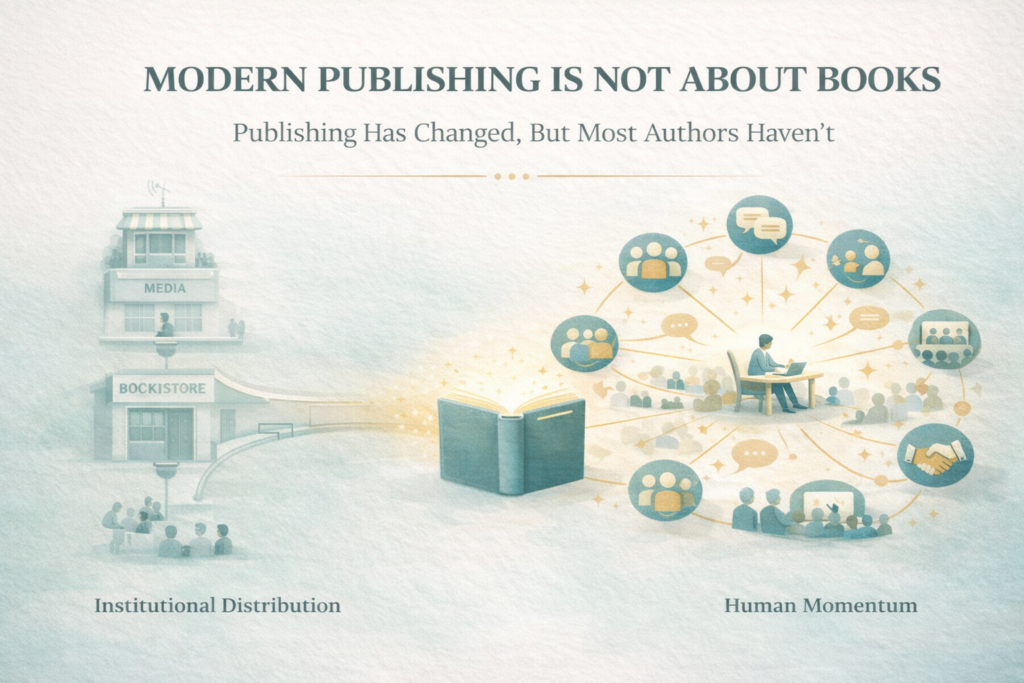
Modern Publishing Is Not About Books
Publishing has changed, but most authors haven’t
For decades, publishing was built around a specific ecosystem:
- bookstores as discovery engines
- gatekeepers as validators
- media as distribution
- advances and shelf placement as the primary leverage
That model shaped the default author sequence: write first, then “market” after publication.
In 2026, that sequence is structurally misaligned with how books actually get discovered, discussed, and turned into professional outcomes.
Modern publishing is built on different foundations:
- direct audiences (people you can reach without intermediaries)
- community-driven launches (momentum created by participation, not announcements)
- author-owned rights (control that enables long-term reuse and leverage)
- presale-first momentum (proof of demand before the book exists)
This is why “publishing” is a misleading word. The printed object is no longer the center of gravity.
The goal is not launching a book. It’s launching an author.
A modern nonfiction book is rarely valuable because it exists.
It is valuable because it changes how the market evaluates the person behind it, especially in high-trust environments like consulting, enterprise services, leadership development, and executive positioning.
When we say “launching an author,” we mean building three things in parallel:
- recognition: the right people can associate the author with a specific problem and point of view
- trust: the author is perceived as credible enough to be hired, invited, or partnered with
- access: there is a clear path for interested readers to engage further (before and after publication)
This is not marketing in the traditional sense. It is the creation of professional leverage.
The core modern author insight: books don’t spread automatically
Most authors implicitly assume that if the book is strong, distribution will do the rest.
But in modern publishing, distribution does not create momentum. People do.
The distinction that matters is behavioral:
- The average reader is passive. They may buy and read, but rarely initiate meaningful word of mouth.
- An early supporter is active. They participate, share, and help the book travel because they feel connected to the outcome.
That is the difference between a quiet release and a book that becomes a reference point inside real conversations.
Presale is the mechanism that creates those early supporters. It turns readers into evangelists by giving them a reason to engage before the book is finished.
Modern publishing is not about pushing a finished book into the world.
It is about building the audience, trust, and participation that make the book inevitable once it arrives.
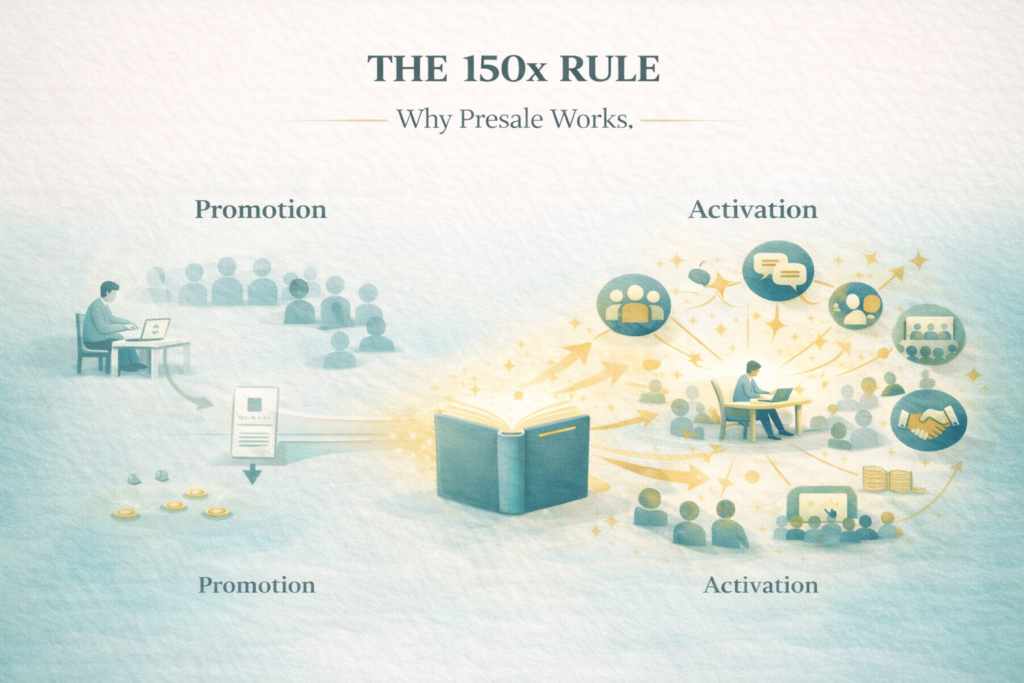
The 150x Rule (Why Presale Works)
The core comparison: promotion vs activation
Most authors default to promotion because it feels like the responsible thing to do: finish the book, then announce it widely.
In practice, there are two fundamentally different actions an author can take:
- Promotion: posting a link and asking people to buy a finished product
- Activation: inviting people into the journey early so they participate before the book exists
Both can produce sales. Only one reliably produces momentum.
The difference is not reach. It is relationship.
The 150x Rule
At Manuscripts, we use a simple rule of thumb to describe what happens when you shift from cold promotion to early activation.
If you post a book link to 100 people who have no relationship to the project, the results are usually small and transactional.
If you activate 100 people into the journey, before the book is finished, those same 100 people can generate orders of magnitude more support.
A shorthand illustration:
- 100 cold connections → ~$15 in purchases
- 100 activated supporters → $2,000+ in support, referrals, and downstream opportunity
We call that gap the 150x Rule.
This is not presented as a universal guarantee. It is a consistent pattern: activated supporters behave differently than passive audiences because their relationship to the book is different.
Why activation changes the economics
Activation improves outcomes because it changes what the book represents to the reader.
A cold audience evaluates the book like a product:
- “Is this worth $20?”
- “Do I have time to read it?”
- “Do I care enough right now?”
An activated supporter evaluates the book like a shared project:
- “I’m part of this.”
- “I want it to succeed.”
- “I know someone who needs this.”
That shift drives three measurable advantages:
- Higher willingness to support: people spend more when the purchase is tied to participation and identity, not just consumption
- Built-in word of mouth: supporters share because they feel involved, not because they were asked to promote
- Earlier downstream opportunities: trust is created before publication, which accelerates conversations that lead to workshops, speaking, advisory work, and partnerships
This is why presale is not “selling early.” It is changing how demand is created.
Invite Marketing
To operationalize activation, we use a simple behavior shift.
Traditional marketing language sounds like:
- “Buy my book.”
Invite Marketing sounds like:
- “I’m building something meaningful. Want to be part of it early?”
That one change matters because it removes the primary friction most professionals feel about outreach:
They don’t want to sell their network.
They are willing to invite their network.
Invite Marketing turns early outreach from a transaction into a relationship-building act. It creates belonging, and belonging is what produces momentum.
The strategic takeaway
If you want a book that launches into a market, promotion is the default.
If you want a book that launches into a community, with early demand, word of mouth, and leverage already in motion, activation is the prerequisite.
The 150x Rule is not about being louder.
It is about involving the right people earlier, so the book starts working before it is finished.
Readers vs. Fans (The Real Divide)
Readers consume. Fans participate.
Most authors design their publishing strategy for readers.
A reader buys the book, reads it, and moves on. The experience is largely private. Even when the book is valuable, the relationship usually ends at the final page.
A fan participates.
They feel connected not just to the ideas, but to the outcome of the work itself. They care whether the book succeeds. They see themselves as part of something being built, not just something being delivered.
This distinction is not rhetorical. It is the difference between a quiet launch and a book that compounds into a platform.
Why readers rarely create momentum
Readers evaluate books as finished products:
- Is this useful to me?
- Is it worth the time?
- Do I agree with the ideas?
Once those questions are answered, the transaction is complete.
Because reading is a solitary act, it rarely produces secondary effects. Most readers do not share the book, introduce the author, or create follow-on opportunity. They are satisfied consumers, but passive ones.
This is why even strong nonfiction books often stall. Consumption alone does not generate momentum.
Why fans change outcomes
Fans behave differently because their relationship to the book is different.
They did not discover the book at the end of the process. They were invited in earlier, while the ideas were forming, while the project was taking shape.
As a result, fans are more likely to:
- talk about the book without being asked
- bring other people into the conversation
- show up to launches, discussions, or events
- support presales and follow-on work
A relatively small group of fans consistently outperforms a large group of passive readers because fans act repeatedly, not once.
Belonging is the mechanism
The difference between readers and fans is not enthusiasm. It is belonging.
Fans feel included in a process rather than marketed to at the end. They understand why the book exists and how their participation matters.
This is why cultural movements outperform media releases. People do not rally around content alone; they rally around identity and shared purpose. Popular culture makes this visible, but the same dynamic applies to business and nonfiction publishing.
Reach creates attention. Belonging creates action.
The design choice modern authors must make
Every nonfiction book makes an implicit design choice:
- Is it built for consumption, where success depends on promotion after publication?
- Or is it built for participation, where momentum is created through early involvement?
Designing for readers prioritizes polish and distribution at the end of the process.
Designing for fans prioritizes invitation, shared ownership, and community formation before the book exists.
Modern authors choose the second path because it produces leverage, durability, and downstream opportunity, not just a launch.
Readers show up at publication.
Fans are built long before it.
How Audience-First Publishing Works in Practice
To see how this works in practice, consider a common pattern we see among Manuscripts authors.
A senior consultant approached us with a strong idea for a leadership book. Like most experts, their instinct was to follow the traditional path: finish the manuscript first, then figure out how to launch it.
But instead of writing in isolation, they reversed the sequence.
Before the manuscript was complete, they began activating their network around the central problem the book addressed.
Over several months they:
reconnected with professional peers and former clients
invited a small group of early supporters into a Reader Advisory Board
shared the evolving ideas behind the book
This process helps you turn ideas into frameworks that strengthen your authority and clarity.
asked for feedback on early frameworks and concepts
This mirrors how strong books are built using research, interviews, and case studies.
This early group grew to roughly 220 people.
These were not passive subscribers. They were participants, professionals who cared about the problem the book was solving and wanted to see the work succeed.
When presale opened, the response was immediate.
Within weeks:
the presale campaign funded the remaining production costs of the book
early supporters introduced the author to organizations interested in workshops and keynotes
the Reader Advisory Board became the foundation of launch events and discussions
By the time the manuscript was finalized, the book was no longer launching into the open market.
It was launching into a community that already cared.
This is the pattern that repeats across industries.
When authors activate readers before the manuscript is finished, the book stops being a private project.
It becomes a shared endeavor that people want to help bring into the world.
And that shift, from isolated writing to community-backed creation, is what makes presale possible.
The Activation Sequence (The Only Way It Works)
Activation is the bridge between audience and presale
By this point, the logic is clear:
- audience-first matters
- fans outperform passive readers
- belonging beats marketing
What is still missing is the bridge, the behavior that turns those ideas into something economically real.
That bridge is activation.
Activation is not a soft concept or a motivational layer. It is the structural step that converts an audience into people who are prepared to support the book when support is offered.
Without activation, presale feels optional.
With activation, presale feels like the natural next step.
Activation is a sequence, not a tactic
Most authors assume that results come from better outreach: better copy, better positioning, better timing.
That assumption is wrong.
Results come from order.
The same invitation performs radically differently depending on what happens before it. Authors fail not because their message is bad, but because they skip the warm-up.
Activation works because it follows a repeatable sequence that lowers social friction and removes the pressure of selling.
Step 1: Engage first
Activation begins with engagement.
Engagement means deliberately reactivating existing relationships through small, human actions:
- liking or commenting thoughtfully on someone’s post
- replying to an email without an agenda
- acknowledging someone’s work or update
This step is not about visibility or algorithms. It is doing psychological work.
Engagement signals recognition. It creates familiarity without obligation. It reopens a relational channel without asking for anything in return.
You are not warming an algorithm, you are warming a human.
Step 2: Invite them in
Only after engagement comes the invitation.
The first invitation is intentionally minimal:
“I’m working on a book and building a small early reader circle. Would you like to be part of it?”
This message is not a pitch.
- there is no sale
- there is no commitment
- there is no transaction
It is an invitation into a role, not a request for support.
By removing the ask, you remove the two biggest blockers most authors face:
- fear of rejection
- fear of sounding salesy
People do not say yes because they are convinced.
They say yes because they are invited early.
Why this sequence works
The effectiveness of activation comes from order.
When authors skip engagement and lead with an ask, the interaction feels extractive. When they engage first and invite second, the interaction feels relational.
This difference shows up consistently:
- cold outreach produces minimal response
- activated invitations produce meaningful participation
Activation turns outreach from something performative into something mechanical, repeatable, predictable, and low-drama.
The data behind activation
The numbers are not the point. They are the permission slip.
Across thousands of interactions, the pattern is consistent:
- cold outreach converts at roughly 1%
- activated invitations convert at roughly 30%
- live conversations convert even higher
The data exists to make one thing clear: failure is not personal, and success is not luck. The system works because the sequence aligns with how people actually make decisions.
Why activation collapses the presale escape hatch
Once someone has engaged and accepted an invitation to participate, support no longer feels like a leap.
It feels like continuation.
Activation is the moment where interest becomes commitment-ready. It is where an audience becomes economically real, even before money is discussed.
This is why modern authors do not debate whether to presell.
Activation makes presale the obvious next step, because the relationship has already been built.
You do not market harder.
You activate earlier.
Presale Publishing (Two Models)
Presale is not optional
If you are not willing to presell your book, you are not ready to publish it.
Presale is how demand is proven before time and capital are fully committed.
Most first-time business authors treat presale as an add-on, something they might do later, once the manuscript is finished.
That belief is the mistake.
Presale (as we use the term) is the structured process of inviting early supporters to back the book before publication so the book launches into an activated community, not into silence.
It is not a retail trick.
It is not a hype tactic.
It is not “early selling.”
Presale is the moment the book becomes economically and socially real, when interest turns into commitment.
If you skip presale, you are not being more authentic. You are making the entire project fragile.
What presale does (and why it changes outcomes)
Presale performs three jobs that traditional publishing used to do for authors, and no longer reliably does:
- Funds production
It reduces financial risk and prevents the book from becoming a cost center the author hopes to earn back later. - Builds word of mouth before launch
It creates supporters who talk, share, and recruit, while the book is still in motion. - Creates a reader community that the book lands inside
The book is received by people who feel part of it, not by strangers who were never waiting.
This is why presale works: the mechanism is not the link. The mechanism is belonging.
The two presale models modern authors use
There are two common ways serious nonfiction authors run presale. Both rely on the same principle, activation before launch, but they operate differently depending on where the manuscript is in the process.
You are not choosing between “presale or Amazon.”
You are choosing which presale model fits your constraints.
Model 1: Announcement Presale (6–9 months out)
What it is
You announce the book before it is finished and invite early supporters to join the journey through a structured presale campaign.
This model is community-first. The book is the center of a shared project, not a product drop.
What supporters typically buy
The offer is not “a book.” The offer is participation + access, often packaged as:
- a launch event ticket
- a signed copy
- name in acknowledgments
- Reader Advisory access (early drafts, feedback, updates)
- workshops or companion perks tied to the book’s topic
Why it works
This model succeeds because it is built on identity and participation. People are not paying for polish; they are backing something they want to exist.
What it enables
It funds the book while you write it, and it builds momentum during the drafting window, so the author is no longer writing in isolation.
This is why Manuscripts favors this model for most first-time business authors: it aligns with the Modern Author sequence (audience → activation → presale → writing), and it removes the “finish first, hope later” risk.
Model 2: Retail Perks Presale (2–3 months out)
What it is
The book is already finished (or effectively finished). Supporters buy it through a retail channel (usually Amazon or a major retailer) and submit proof of purchase to receive bonuses.
This model is list-driven. The structure is designed to coordinate purchases inside a tight window.
How it works in practice
Supporters buy the book retail → they send a receipt → they receive perks such as:
- a workshop or training
- a bonus chapter or toolkit
- a private Q&A
- a digital bundle tied to the book’s promise
Pros
- Integrates with bestseller list mechanics and retail distribution norms
- Familiar to audiences who expect “preorder + bonuses”
Cons
- The author typically must front-load cost and logistics
- It assumes the author already has enough activation to coordinate volume
- It happens late, which means it does not fund the writing process
The key distinction
This model still relies on activation, just closer to launch. Even the most successful “retail presales” are not powered by retail discovery. They’re powered by organized audiences.
If the book is meant to unlock consulting, speaking, or enterprise work, start with an announcement presale.
If the book already has an existing mass-market audience, use retail perks, but only after demand is clear.
What matters most: you cannot skip the bridge
The purpose of these two models is flexibility, not optionality.
There are different ways to run presale depending on timing, constraints, and goals. But there is no version of modern authorship where you finish the book first and hope attention shows up later.
Presale is where the book stops being a private project and becomes a supported platform asset.
In modern publishing, that shift is not a bonus step.
It is the business model.
The Economics (Why Most Books Lose Money)
Why most publishing advice survives: the economics are hidden
Most authors get bad guidance for one simple reason: they never see the numbers.
When outcomes are unclear, optimism fills the gap. Authors assume their book will be “different,” not because they have a system, but because they are committed and the idea matters.
Commitment is not a business model.
Without presale demand, most nonfiction books are financially irrational to produce.
This section uses median outcomes because median is what happens to serious, competent authors who are not celebrities, not viral, and not exceptions.
Traditional publishing is not a financial solution
Many executives assume traditional publishing solves the money problem:
- “A publisher will handle distribution.”
- “A publisher will create demand.”
- “A publisher will make the book profitable.”
In reality, traditional publishing optimizes for distribution, not author economics.
Even when the book is “successful” by industry standards, the author’s financial outcome is often modest because:
- royalties are delayed and thin
- sales volume is unpredictable
- most demand still depends on the author’s platform
Traditional publishing can be valuable for positioning and reach. But it is not a reliable way to recoup the time, opportunity cost, and production investment of a serious nonfiction book.
Self-publishing is harsher without demand
The common counter-move is:
“Fine. I’ll self-publish and keep control.”
Control does not fix the core issue: demand.
Without an activated audience, self-publishing tends to expose the economics faster:
- you pay for editing, design, and production upfront
- you carry all launch risk
- you still have to create discovery and word of mouth yourself
If the book launches to silence, the “higher royalty rate” becomes irrelevant. You are keeping more of an outcome that doesn’t exist.
The core problem: books don’t recoup without waiting readers
Most nonfiction books don’t fail because the writing is bad.
They fail because nobody was waiting.
A book with no pre-activated demand is a high-effort asset launched into a low-attention environment:
- bookstores are not discovery engines
- media is not scanning for new authors
- algorithms do not reward announcements
Without early supporters, the book must create momentum after publication, when the cost is already sunk and the author’s energy is already spent.
That is why “publish first, monetize later” is structurally fragile.
Presale changes the math before money is spent
Presale reframes the book from a cost center into an asset.
It does this by moving risk upstream:
- before the book is finished
- before the production budget is fully committed
- before launch week becomes a make-or-break moment
Without presale, the book is a cost center. With presale, it becomes an asset before it is finished.
Economically, presale is not “extra.”
It is the only step in the sequence that allows you to validate demand, fund the work, and build momentum while the book is still being built.
The baseline shift: from recovery to upside
When presale is done correctly, the author is no longer trying to “earn back” the cost of the book after launch.
The book is already supported.
That changes how everything feels and functions:
- production is funded instead of deferred
- launch becomes coordination, not hoping
- post-launch sales are not recovery, they’re upside
- downstream outcomes (clients, speaking, enterprise interest) are amplified because the book is already landing inside a community
The economic point is simple:
Publishing without presale isn’t just risky.
It is mathematically irrational.
Common Mistakes Modern Authors Make
Once authors understand the economics of publishing, the next question is obvious:
If audience-first publishing works so reliably, why do so many books still launch into silence?
In practice, the issue is rarely effort or intelligence. It is sequence.
Authors make a small set of predictable mistakes that undermine momentum before the book ever reaches readers.
Mistake 1 — Writing in isolation
The traditional model encourages authors to disappear for months or years to finish a manuscript before involving anyone else.
This feels productive, but it creates two problems at once.
First, the author receives no real signal about whether the ideas resonate. The book develops without feedback from the people it is meant to help.
Second, the launch begins from zero. When the manuscript is finally complete, the author must suddenly generate attention, trust, and demand all at once.
Modern authors reverse this sequence.
They bring readers into the process early so the book develops with real signal and launches into a community that already exists.
Mistake 2 — Treating presale like a discount
Many authors misunderstand presale as a pricing tactic.
They assume presale means offering the book early at a lower price in order to encourage quick purchases.
That approach misses the point.
Presale is not about price. It is about participation.
Early supporters are not simply buying a book. They are backing a project they want to see exist. The value comes from belonging, access, and involvement in the process.
When presale is framed this way, the dynamic changes from a transaction to a shared endeavor.
Mistake 3 — Waiting until launch to activate readers
Another common mistake is postponing reader engagement until the book is finished.
Authors assume they will “start marketing” once the manuscript is complete.
By that point, the opportunity to build momentum gradually has already passed.
Activation works because it begins early.
When readers are invited into the journey before publication, they become invested in the outcome. The launch then becomes a continuation of a conversation rather than a sudden announcement.
Mistake 4 — Building an audience but never activating it
Some authors do build an audience.
They collect subscribers, accumulate followers, or grow a professional network over time.
But when the book arrives, those people remain passive observers.
Audience alone does not create momentum.
Activation is what converts attention into participation. It invites readers into a role, early supporter, advisor, evangelist, rather than leaving them as distant spectators.
Modern authors understand that an audience is potential energy.
Activation is what turns that potential into real momentum.
The pattern behind these mistakes
Each of these mistakes comes from the same assumption: that writing the book is the main task and everything else happens afterward.
Modern authors understand the opposite.
Writing is one part of the system.
Audience-building, activation, presale, and community formation are what allow the book to do real work in the world.
When the sequence is correct, momentum builds before publication instead of after it.
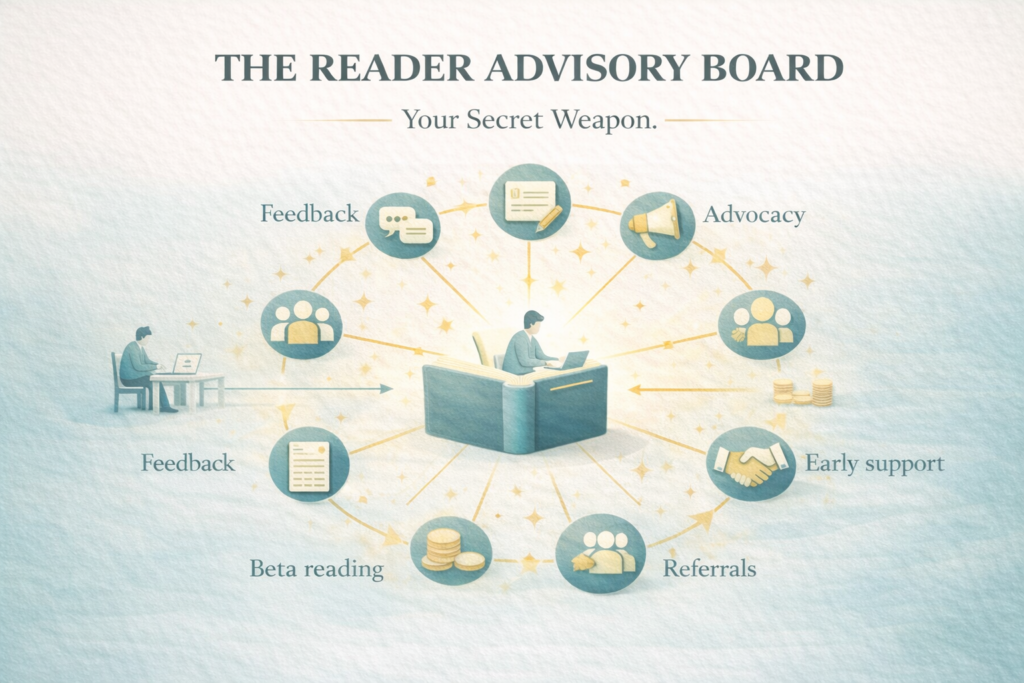
The Reader Advisory Board (Your Secret Weapon)
What the Reader Advisory Board actually is
A Reader Advisory Board (RAB) is a defined group of early supporters who are formally invited into the life of the book before it exists.
This is not a mailing list.
It is not a launch team.
It is not a vague community.
A Reader Advisory Board is the container where:
- activation becomes durable
- presale momentum stabilizes
- feedback, advocacy, and referrals originate
If the earlier sections explain why modern authors build audience first, the Reader Advisory Board explains where that audience actually lives.
Why the RAB is the structural center of the system
Without a Reader Advisory Board, the system feels fragmented:
- outreach here
- invites there
- presale later
- launch pressure at the end
With a Reader Advisory Board, everything has a home.
Activation feeds into it.
Presale happens inside it.
Momentum compounds because relationships persist.
This is why the RAB is not a tactic.
It is the operating system of author-owned publishing.
Redefining “audience” as participation
Most authors think of an audience as:
- followers
- subscribers
- buyers
The Reader Advisory Board reframes audience as participation.
RAB members are not passive. They become:
- beta readers who shape the book
- evangelists who talk about it naturally
- early buyers who create momentum
- long-term audience who stay beyond launch
- a referral engine that compounds over time
The same people create every outcome when they are activated properly.
This is leverage through relationship, not scale.
One structure that solves five problems at once
The Reader Advisory Board quietly collapses multiple author fears into a single solution:
- “What if I write the wrong book?” → feedback
- “What if nobody talks about it?” → evangelists
- “What if sales are weak?” → early buyers
- “What happens after launch?” → long-term audience
- “How do I grow without constant posting?” → referrals
Instead of building separate systems for each concern, the RAB centralizes them.
That is why it is a secret weapon.
Why presale works inside a Reader Advisory Board
Presale works best when it feels like a continuation, not a request.
Inside a Reader Advisory Board:
- people have context
- people feel included
- people feel ownership
Support does not feel transactional because it isn’t.
People are backing something they helped shape.
This is why presale inside an RAB feels natural rather than salesy.
It is not persuasion.
It is participation turning into commitment.
The size that actually matters
A Reader Advisory Board is typically 200–300 people, built over time.
This number is intentional:
- small enough to feel human
- large enough to create momentum
- achievable without an existing platform
You are not recruiting strangers.
You are organizing people you already have access to.
The RAB grows gradually as activation compounds. It does not need to exist fully formed on day one.
The identity shift that changes everything
The Reader Advisory Board also reframes the author’s role.
Not:
- content creator
- promoter
- marketer
But:
- host
- curator
- leader of a project people choose to support
Authors who see themselves as hosts invite differently, show up differently, and sustain momentum longer.
The Reader Advisory Board gives the author something real to lead, and a reason people stay.
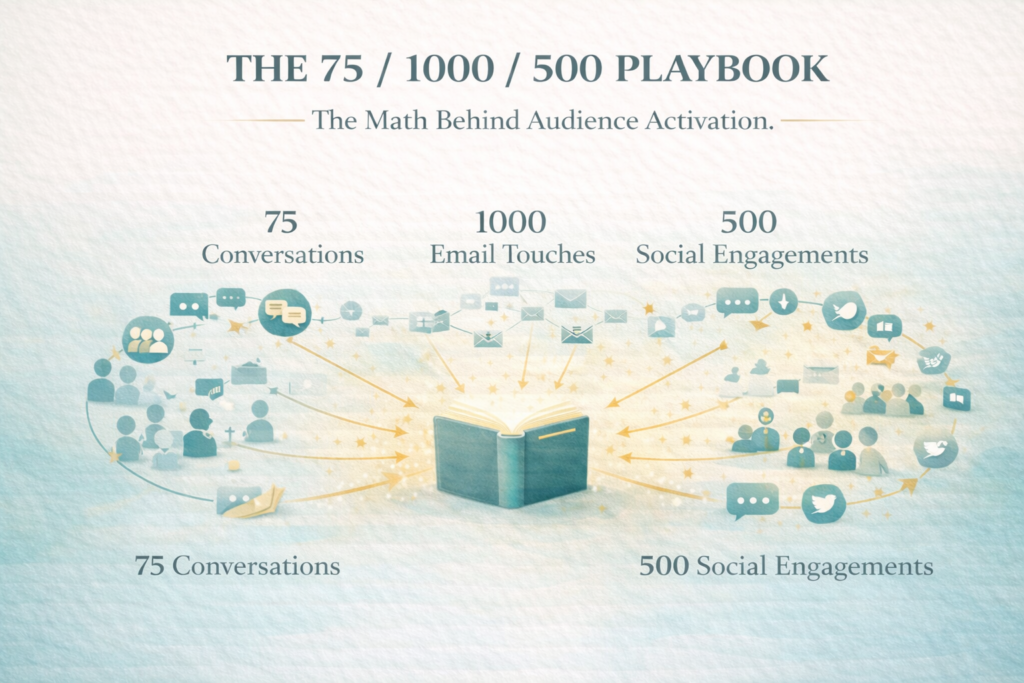
The 75 / 1000 / 500 Playbook
Why audience-building feels harder than it is
Most authors assume audience-building is unpredictable.
They believe:
- some people are just better at it
- success depends on charisma or consistency
- results require endless posting
None of that is true.
What actually drives fan-building is throughput, a sufficient number of real, human interactions layered in the right order.
This section exists to replace mystery with math.
The Modern Author Fan Theory
At Manuscripts, we’ve seen the same pattern repeat across industries, seniority levels, and platforms.
Roughly:
- 75 direct conversations
- 1000 email touches
- 500 social engagements
…consistently produces 200+ activated fans when done with the activation sequence described earlier.
This is not a formula for going viral.
It is a volume model for creating belonging.
These numbers fail when treated as quotas instead of conversations.The goal is relationship activation, not inbox completion.
The goal is relationship activation, not inbox completion.
What these numbers actually represent
These numbers are not goals to obsess over.
They are ceilings, not floors.
They define the outer boundary of effort required to build a viable early audience.
The work is finite.
The inputs are knowable.
The outcome is predictable.
That alone removes a massive amount of anxiety.
Why the channels are different, and why that matters
Each layer of the playbook serves a different depth of activation.
75 conversations
- High-trust, high-context interactions
- Where commitment forms
- Where presale conversion happens
These are not sales calls.
They are short check-ins, DMs, reconnections, and human conversations.
1000 email touches
- Medium-depth activation
- Reinforces identity and relevance
- Keeps the project present over time
Email works because it creates repetition without pressure.
500 social engagements
- Light activation
- Familiarity and warmth
- Low-friction visibility before invites
This is not about posting constantly.
It is about being visibly present to the people who already know you.
Together, these layers create momentum without relying on any single channel.
Why this is manageable for busy professionals
This playbook is designed for people with real jobs.
It does not require:
- daily posting
- personal branding theatrics
- becoming a full-time creator
Seventy-five conversations spread over weeks or months is achievable.
A thousand emails sent over time is normal business communication.
Five hundred social engagements can be accumulated passively through attention, not performance.
The system bends around your life.
Your life does not need to bend around the system.
Reliability is the point
When Manuscripts says this playbook “reliably produces” results, that language is intentional.
This is not:
- best-case performance
- top 1% outcomes
- influencer math
This is what happens when the system is followed competently.
You do not need scale.
You do not need virality.
You need enough human contact, applied in the right sequence.
Confidence comes from completion
Before this playbook, confidence comes from hope.
Motivation comes from inspiration.
After it, confidence comes from:
- progress
- numbers checked off
- work completed
Audience-building stops being an identity project.
It becomes a finite, executable phase.
And once the inputs are complete, the output follows.
When the System Works: What Happens Next
The outcome is not book sales, it’s leverage
Most authors still define success as copies sold.
That framing is too small.
When the Modern Author system is followed, the primary outcome is not a spike in book sales.
It is leverage.
The book becomes a forcing function that unlocks:
- speaking engagements
- enterprise opportunities
- partnerships
- inbound demand
- long-term authority
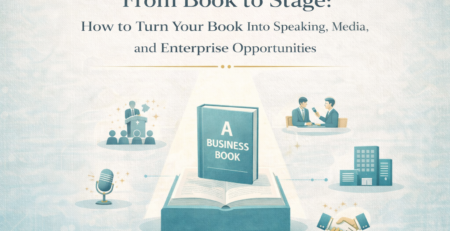
This is how authors move from book to stage, turning ideas into real-world opportunities.
Sales still matter.
But they are no longer the ceiling.
They are the entry point.
Why these outcomes repeat
The results in this guide are not anomalies.
They repeat because the system compounds.
Community does not consume effort the way marketing does.
It multiplies it.
When people feel part of something:
- one invite leads to multiple referrals
- one launch leads to ongoing events
- one book leads to several revenue streams
Momentum does not reset after launch week.
It carries forward.
This is why Modern Author outcomes look disproportionate to the size of the audience.
The pattern across successful authors
Across industries, roles, and starting points, the same pattern appears.
In practice, the Modern Author system looks like this:
- An early announcement activates people before the book exists
- A Reader Advisory Board turns interest into participation
- Presale creates commitment and visibility
- The book launches into a waiting community
From there, downstream outcomes follow naturally:
- launch events scale beyond expectations
- audiences open doors the author never pitched for
- the book becomes shorthand for expertise
Different authors.
Same structure.
That is the signal.
Identity shift is the real transformation
The most important change is not external.
It is internal.
Before:
- “I wrote a book.”
- “I hope people buy it.”
After:
- “I’m hosting a project people care about.”
- “People are waiting for what I build next.”
This is why the line matters:
Your book becomes a community asset before it becomes a product.
That shift changes:
- how the author invites others
- how peers introduce them
- how opportunities find them
Authority stops being claimed.
It starts being granted.
Why case studies matter here
These examples are not included to impress.
They exist to remove the final objection:
“But I’m different.”
Across Manuscripts authors, the same pattern appears when audience-building and activation happen before the manuscript is finished. A few examples illustrate how the system plays out in practice.
1). Executive Coach (Leadership Book)
Built a Reader Advisory Board of roughly 240 early supporters drawn from past clients, professional peers, and leadership program alumni.
Ran a structured presale campaign tied to launch events and advisory access.
Presale generated approximately $85,000 in early support and funded the remaining production costs.
Launch events drew more than 600 attendees, and the book became the central authority asset for the author’s consulting practice.
2). Startup Founder (Industry Playbook)
Activated an early community through an existing newsletter and founder network months before the manuscript was complete.
Invited readers to participate in shaping frameworks and examples during the writing process.
Presale support funded book production and created early momentum across the startup ecosystem.
After launch, the book became a gateway into enterprise advisory work and conference speaking.
3). Strategy Consultant (Professional Services Book)
Reactivated dormant LinkedIn relationships and professional contacts over a 90-day activation period.
Built a Reader Advisory Board of more than 200 early supporters interested in the book’s core problem area.
Presale participation created the first wave of word-of-mouth momentum.
Within months of publication, the book generated inbound consulting inquiries and workshop invitations.
4). Enterprise Leader (Management Framework Book)
Invited colleagues, former clients, and leadership peers into a Reader Advisory Board during the drafting phase.
Shared early frameworks and chapter ideas with the group, creating participation and feedback loops.
Presale support created an early demand signal before the manuscript was finalized.
The book later became the foundation for internal leadership programs and executive briefings.
Different backgrounds.
Different industries.
Different starting audiences.
Same sequence.
Same outcomes.
When a pattern holds across contexts, it is no longer inspiration.
It is evidence.
What comes next is not optional
This section is not a conclusion.
It is a transition.
Once the reader sees the pattern, the question is no longer if the system works.
It is when they choose to follow it.
The remaining sections are not about possibility.
They are about execution.
The system is already proven.
What happens next depends on whether it is applied.
The Modern Author Timeline
The book is one phase, not the project
Most authors carry a quiet assumption:
Finish the manuscript, and the hard part is over.
That assumption is why so many books stall.
In modern authorship, the manuscript is only one phase inside a longer system. Writing is necessary, but it is not sufficient. What determines outcomes is how the writing phase connects to activation, presale, and launch.
A realistic Modern Author timeline separates these phases on purpose.
Two timelines most authors confuse
There are two different clocks at work:
- Manuscript draft: approximately 4–6 months
- Full author business and launch cycle: approximately 11–14 months
When these are collapsed into one rushed effort, authors experience:
- pressure to monetize too late
- financial risk concentrated at launch
- burnout before momentum ever arrives
Finishing the manuscript does not mean finishing the work. It means entering the highest-leverage phase.
The pause is not delay, it is leverage
Most authors treat the space between:
- “The book is written”
- “The book is published”
as dead time.
In the Modern Author system, that pause is where value is created.
This is when authors:
- announce the book intentionally
- activate early readers
- run presale campaigns
- form the Reader Advisory Board
This phase turns the book from a private artifact into a public project. It is where demand is built instead of guessed.
Why this sequence prevents burnout and regret
Burnout does not come from writing.
It comes from stacking everything at once.
Authors burn out when they:
- write under financial pressure
- rush to publish without momentum
- attempt marketing and launch while emotionally depleted
A structured timeline removes that load.
By sequencing:
- writing first
- activation second
- presale before launch
authors distribute effort instead of compressing it. Stress drops. Confidence rises. Momentum builds before publication instead of after.
Patience is a signal of professionalism
An 11–14 month cycle is not slow.
It is intentional.
Planning this way signals:
- long-term thinking
- seriousness about outcomes
- respect for the book as an asset
This is the difference between hoping a book “does something” and designing it to do specific work in the world.
Modern authors plan like builders, not gamblers.
Where everything fits
This timeline integrates the entire system:
- Audience building precedes writing completion
- Activation feeds presale
- Presale funds production and builds community
- The Reader Advisory Board compounds beyond launch
- Publishing becomes an inflection point, not a finish line
The question is no longer what to do.
It is when each part happens.
Once the timeline is clear, execution stops feeling abstract. It becomes schedulable.
And that clarity is what makes the final checklist possible.
FAQ for Busy Executives
Even after understanding the Modern Author system, experienced professionals tend to ask the same practical questions before committing to an audience-first book strategy.
Here are the most common ones.
1). Do I need a large social media following to do this?
No.
The system is designed around relationships, not reach.
Most successful presale campaigns begin with people the author already knows: colleagues, clients, peers, alumni networks, and professional communities.
A Reader Advisory Board of 200–300 people is typically enough to create meaningful early momentum.
2). What if I’m not comfortable “marketing” to my network?
The system is not built around promotion.
It is built around invitation and participation.
Instead of asking people to buy something, the author invites them into the process of creating a book that addresses a shared problem.
For most professionals, this feels far more natural than traditional marketing.
3). When should I start building the audience?
Ideally, before the manuscript is finished.
Audience-building and activation work best during the writing process, when readers can still participate in shaping the ideas and frameworks.
This early involvement is what turns passive readers into active supporters.
4). Do I need to finish the manuscript before running presale?
No.
In fact, presale often works better before the manuscript is complete.
When readers support the project early, they feel invested in the outcome and more likely to advocate for the book later.
Presale becomes a signal that the book matters, not just that it exists.
5). How long does this process typically take?
For most professionals, the full Modern Author cycle runs 11–14 months from initial audience-building to launch.
That timeline includes:
audience activation
Reader Advisory Board formation
presale campaign
manuscript completion
launch preparation
The result is a book that enters the market with momentum already attached.
6). What if I already finished my manuscript?
You can still implement most of this system.
Activation and presale can begin even after the manuscript is drafted.
The key shift is involving readers before the public launch, so the book still enters the world with a community behind it.
7). Is this approach only for business authors?
It works best for nonfiction books designed to create professional leverage, such as:
consulting and advisory work
speaking opportunities
executive positioning
industry authority
category leadership
In those contexts, the book functions as a platform asset rather than just a product.
The Modern Author Presale Checklist
This guide has already done the strategic work.
If the reader closes it and waits for more certainty, the outcome is predictable: the book gets postponed, the audience never forms, and the launch becomes a last-minute request for attention.
The Modern Author system only requires one thing now: a starting sequence.
What follows is that sequence, eight steps, in order, designed to be executable without hype, jargon, or a personality transplant.
The Starting Sequence
1) Identify 100 people
Build a list of real humans you already have access to: colleagues, peers, clients, former clients, collaborators, friends, and dormant connections.
This is not a list of “leads.” It is a map of relationships.
2) Engage for two weeks
Before you invite anyone into a book journey, re-establish presence through small interactions: replies, comments, check-ins, and acknowledgments.
This creates warmth and permission without asking for anything.
3) Invite them into the Reader Advisory Board
A Reader Advisory Board (RAB) is a small, intentional group of early supporters who participate in the book’s development and launch.
Your invite should be simple: you’re building a book, you’re forming a small early-reader circle, and you’d like them to be part of it. No pitch. No pressure.
4) Build the RAB container
Give the group a home, typically an email list and one simple community space. Name it and make it explicit.
This turns “audience building” into a durable asset you can point to, manage, and grow.
5) Build the presale offer
Design a small set of support options tied to participation, not discounts. Examples include: early access, acknowledgments, signed copies, launch tickets, workshops, or advisory involvement.
The goal is not clever pricing. The goal is structured ways for supporters to say “I’m in.”
6) Announce with belonging language
Announce before the book is finished. State what you are building and who it is for, then invite people into the journey early.
This is the shift from promotion to participation: you are not asking people to buy a finished product, you are inviting them to help bring something into existence.
7) Run the campaign and activate evangelists
During the presale window, communicate consistently with your Reader Advisory Board and supporters. Acknowledge participation, share progress, and make sharing natural.
This is where momentum becomes self-reinforcing: one supporter turns into three introductions, one update turns into five replies.
8) Finish the manuscript with momentum
Only after the audience is activated do you return to the manuscript as the final execution phase.
At this point, writing is no longer speculative. Readers exist. Support exists. Demand exists. The manuscript becomes fulfillment, not a leap of faith.
What this checklist is really doing
It removes the hidden friction that keeps competent people from moving:
- You are not guessing what to do next. You are following a sequence.
- You are not relying on motivation. You are completing steps.
- You are not “being salesy.” You are timing invitations correctly.
- You are not building an audience forever. You are building an asset on purpose.
Modern authors do not wait for confidence and then act.
They act in sequence, and confidence shows up as a byproduct.
Final CTA
If you want your book to launch inside a community instead of into silence, and you’re serious about building a book that functions as a real business asset, we can help.
We’ll show you how to implement this system for your audience, your calendar, and your goals.
Map Your Modern Author Strategy
If you want to:
- Pressure-test your author model
- Clarify realistic outcomes
- Understand where ROI is likely to show up
- Avoid unnecessary spend
A short strategy conversation can surface issues early, before they become expensive.
Schedule a Modern Author Strategy Session
This is a working session, not a pitch.
Explore the Modern Publishing System
If you’re assessing:
- Whether to publish traditionally, hybrid, or independently
- How to structure presale and early activation
- What support actually reduces risk
You may want a clearer view of how the Modern Publishing System works in practice.
Explore Manuscripts Publishing Services
Study Real Author Outcomes
(For internal validation and stakeholder alignment)
If you’re preparing a recommendation for leadership, concrete examples often help.
See Modern Author Success Stories
About the Author
Eric Koester is an award-winning entrepreneurship professor at Georgetown University, bestselling author, and founder of Manuscripts. His work focuses on how ideas become assets, how books create leverage, and why modern authors need systems, not just publishing support.
He has worked with thousands of authors across traditional, hybrid, and modern publishing paths, helping them turn books into platforms, platforms into credibility, and credibility into durable business outcomes.
About Manuscripts
Manuscripts is the Modern Author OS for nonfiction experts.
We help founders, executives, coaches, and thought leaders design books as strategic assets, not standalone products. Our work spans positioning, author model design, developmental editing, AI-enhanced drafting tools, presale strategy, and long-term launch systems.
Manuscripts authors use their books to generate clients, speaking engagements, training programs, and enterprise opportunities, often before publication.
For readers who want to go deeper into specific mechanics, the following guides expand on topics referenced in this report:
- How to Write a Book if You’re Busy
- Modern Ghostwriting for Nonfiction Authors
- AI Tools for Authors in 2026
- How to Build an Audience Before You Write Your Book
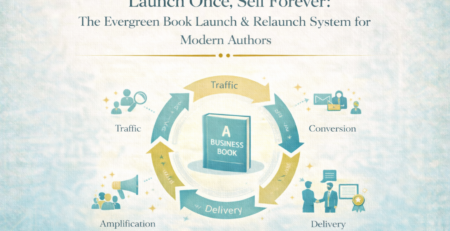
- The Evergreen Launch System for Modern Authors
Powered by Codex, the Modern Author Intelligence Tool.




Leave a Reply