

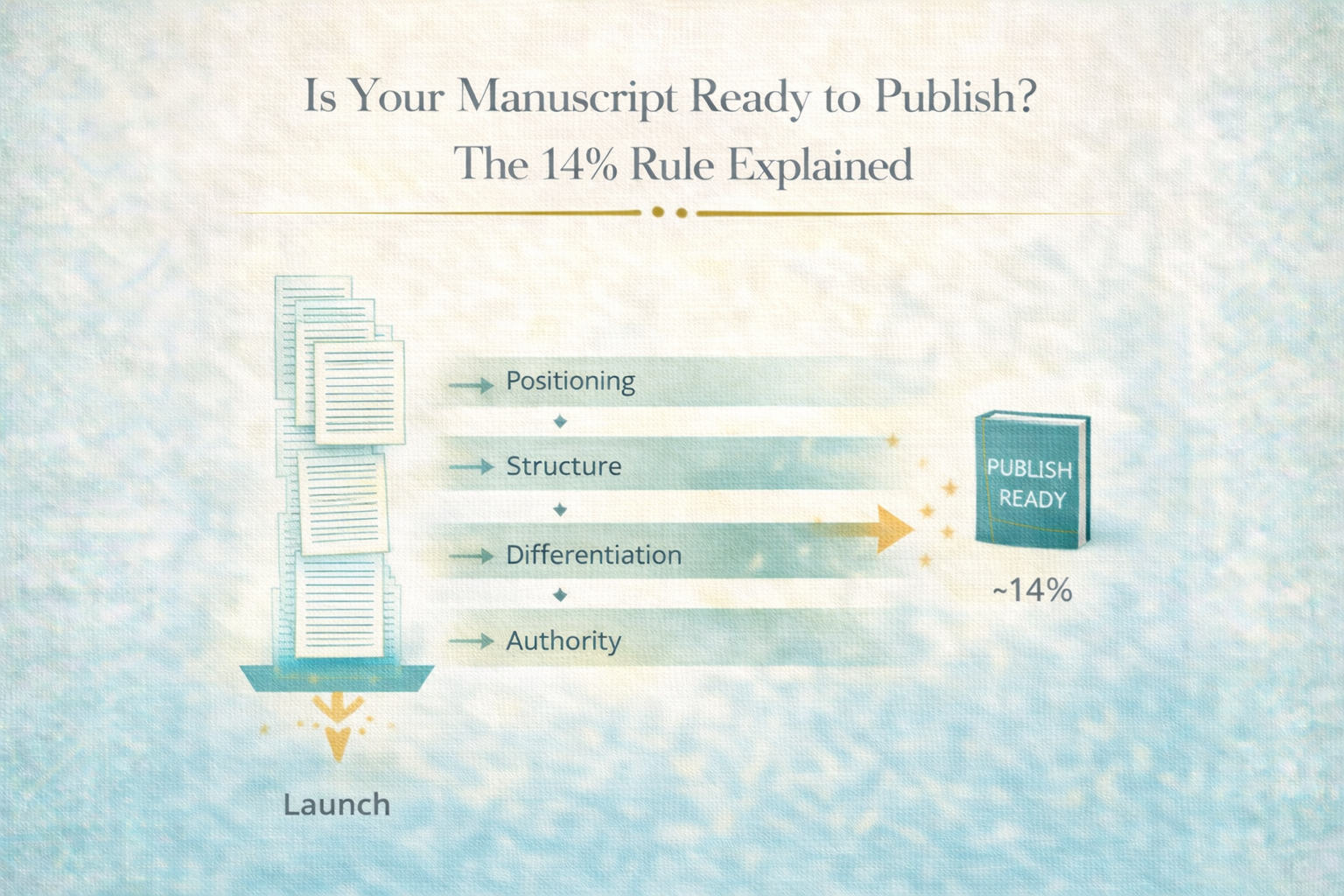
Is Your Manuscript Ready to Publish? The 14% Rule Explained
Most nonfiction manuscripts feel “ready” at the exact moment they become dangerous.
The draft is complete. The chapters are in place. The prose has been cleaned up. You can finally picture the cover.
But readiness is not a feeling. It’s exposure tolerance.
Publishing is not the moment you finish writing. It’s the moment you let the market examine your thinking, at scale, permanently, under search, under screenshots, under referrals, under skepticism.
That’s why the 14% Rule exists.
Only a small fraction of finished nonfiction manuscripts are structurally ready for publication without reconstruction, not because the writing is bad, but because the architecture is untested.
This brief gives you a clean way to diagnose which side you’re on.
The 60-Second Decision
Your manuscript is likely ready if:
- You can state a differentiated thesis in one sentence (not generic, not broad, not “my story + lessons”).
- Your chapters escalate a coherent strategic argument (each chapter changes the reader’s understanding, not just adds information).
- Your core framework is named, ownable, and diagrammable (it can be taught, repeated, remembered).
- Your positioning has been validated before publication (real readers, real feedback, real signal).
- The book integrates directly with your authority or revenue model (what it unlocks is explicit).
Your manuscript is likely not ready if:
- Completion is your primary readiness metric (“It’s done.”).
- Editing focused on grammar and style, not architecture.
- Frameworks are implied but not defensible (“I kind of cover it throughout.”).
- Audience validation has not occurred (no pre-launch signal, no feedback loop).
- The book exists independently of your business strategy (“We’ll figure out the ROI later.”).
Rule: Completion is not readiness. Architecture determines exposure strength.
Who This Brief Is For
This brief is for authority-driven nonfiction authors, Modern Authors, who are asking a specific question:
“Is my manuscript structurally ready for market exposure?”
That includes:
- Founders writing category-defining books
- Consultants refining signature frameworks
- Coaches scaling premium offers
- Executives formalizing intellectual property
- Speakers positioning for enterprise demand
This is not for hobbyists chasing “publish for fun.”
It’s for authors whose book has a job to do.
The Readiness Gap Most Authors Miss
Finished Does Not Mean Ready
Most serious nonfiction manuscripts reach a familiar milestone:
- 60,000–80,000 words
- “Edited” and polished
- Clean enough to ship
And yet still structurally unstable.
A manuscript can be well-written and still fail as an authority asset.
Because readiness isn’t a property of sentences.
It’s a property of the system:
- positioning clarity
- structural coherence
- market differentiation
- authority integration
Internal observation (across draft reviews, structural assessments, and revisions): fewer than ~15% of finished nonfiction manuscripts are market-ready without structural intervention.
Why it matters: Production quality ≠ strategic resilience.
The Real Risk Is Irrelevance, Not Rejection
Most authors fear:
- negative reviews
- low sales
- criticism
But the more common failure is quieter:
- weak positioning
- an undifferentiated thesis
- a framework that isn’t defensible
- no urgency
- no clear “why now”
The book lands politely.
No controversy. No backlash. No momentum.
That kind of quiet failure erodes authority more than criticism, because it proves the book didn’t matter.
Why it matters: Publishing is exposure. If the manuscript can’t carry exposure, the market won’t attack it, it will ignore it.
The 14% Rule: A Structural Readiness Test
Before you ask, “Is my manuscript good?” ask a sharper question:
If this book went live tomorrow, would exposure strengthen my authority, or reveal structural gaps?
That is the real decision.
The 14% Rule is not a statistic for shock value.
It is a screening model.
Roughly 1 in 7 nonfiction manuscripts are structurally ready for publication without reconstruction, not because writing is rare, but because architecture is.
The comparison is simple:
- Most manuscripts are built through accumulation.
- Ready manuscripts are built through design.
A manuscript qualifies only if it passes all four structural filters.
1. Positioning Clarity
Test: Can you state a differentiated thesis in one sentence that a skeptical reader would recognize as distinct?
Example of failure:
“This book explores leadership in modern times.”
Example of readiness:
“This book argues that operational clarity, not charisma, is the primary driver of scalable leadership, and introduces a repeatable framework to build it.”
Application:
If your thesis cannot be written without soft words (“explores,” “shares,” “journey”), you likely have a positioning issue, not a prose issue.
2. Structural Integrity
Test: Does the book escalate logically, with each chapter advancing the argument rather than circling themes?
Failure pattern:
- Chapters feel individually strong.
- But the order could be rearranged without consequence.
- The argument does not intensify.
Ready pattern:
- Early chapters define the problem.
- Middle chapters introduce and defend the framework.
- Later chapters apply, pressure-test, and extend it.
- The reader’s understanding shifts progressively.
Application:
If you can remove a chapter without weakening the core thesis, the structure is likely additive, not architectural.
3. Market Differentiation
Test: Is your central idea ownable and defensible, or interchangeable with adjacent books?
Failure pattern:
- “There are many books like this.”
- The value is competence, not category shift.
Ready pattern:
- The idea can be diagrammed.
- The framework can be named.
- The book occupies a clear position in the landscape.
Application:
If your framework cannot be sketched on a whiteboard and defended under critique, it is not yet differentiated.
4. Authority Integration
Test: Does the book connect explicitly to your authority ecosystem or revenue model?
Failure pattern:
- The book is “about” your expertise.
- But it does not change how clients, stages, or enterprise partners perceive you.
Ready pattern:
- The book clarifies what you are known for.
- It supports consulting, speaking, licensing, or premium offers.
- It sharpens, not dilutes, your market position.
Application:
If someone asked, “What does this book unlock for you?” and the answer is vague, authority integration is missing.
Why Most Manuscripts Fail the 14% Rule
Most authors build drafts from:
- ideas
- stories
- research
- lived experience
That is natural.
But readiness is not the result of accumulation.
It is the result of deliberate structural design.
Most manuscripts fail at least two of the four filters, not because the author lacks intelligence, but because architecture was never imposed.
Recommendation
Treat the 14% Rule as a diagnostic gate, not a discouragement.
Before publishing:
- Run your manuscript through all four filters.
- Identify which fail.
- Rebuild those structurally, not cosmetically.
Do not ask, “Is it finished?”
Ask:
Does it pass all four filters under scrutiny?
Only then is it ready for exposure.
Quick Comparison Table: Finished Draft vs. Publish-Ready Manuscript
| Dimension | Typical Finished Draft | Publish-Ready Manuscript (14%) |
| Core thesis | Broad or implied | Clear, differentiated, defensible |
| Structure | Chapter list | Strategic progression and escalation |
| Framework clarity | Present but loose | Named, ownable, diagrammable |
| Positioning sharpness | “I cover a lot” | “This is what this book uniquely does” |
| Editorial depth | Copy + line edits | Developmental + structural intervention |
| Audience integration timing | Post-production marketing | Pre-launch validation and signal |
| Business alignment | Indirect | Explicit: what it unlocks is clear |
| Primary tradeoff | Speed to completion | Time invested in strategic rigor |
This is why many books feel “ready” and still underperform.
They were finished as manuscripts.
They were not finished as assets.
Deep Breakdown: Common Failure Modes
A. Strong Writing, Weak Positioning
This is the most common case.
The prose is competent. The author is credible. The information is useful.
But the promise is vague.
- The reader can’t repeat the thesis.
- The book doesn’t carve a clear category position.
- The argument could belong to ten other books.
Result: a respectable book that doesn’t shift perception.
What to look for:
If you can’t write your thesis in one sentence without using soft words (“about,” “explores,” “journey,” “lessons”), you likely have a positioning problem, not a writing problem.
B. Narrative Over Framework
Stories are powerful. But authority is built on models.
Many manuscripts lean on narrative because narrative is easier to produce than formal structure.
- the reader enjoys the stories
- the author feels authentic
- the book reads smoothly
But the book cannot be taught.
If the idea cannot be diagrammed, it cannot be defended.
If it cannot be repeated, it cannot compound.
What to look for:
If your reader can’t name “your thing” after finishing, you don’t have IP. You have content.
C. Editing Without Structural Intervention
Many authors confuse editing with readiness.
They pay for:
- proofreading
- copyediting
- line-level improvement
And the manuscript becomes cleaner.
But the architecture remains unchanged.
A copyedited book can still be strategically incoherent.
It can still have:
- a diluted promise
- a non-escalating structure
- a framework that never solidifies
- a category position that never sharpens
What to look for:
If your edits improved style but did not change argument structure, chapter logic, or thesis clarity, you likely improved polish without improving readiness.
D. No Audience Validation Loop
A manuscript can be structurally sound and still misfire if positioning is untested.
Without validation, authors rely on internal confidence.
But markets don’t reward confidence.
They reward fit.
If you don’t run a pre-launch feedback loop,through presale signal, pilot readers, list engagement, or structured positioning tests, you launch blind.
What to look for:
If the first time your thesis meets real readers is publication day, you have treated the market as a judge instead of a feedback system.
What Survives After Publication
A manuscript is not ready simply because it can be printed.
It is ready only if something endures beyond the pages.
For Modern Authors, the book is not the full asset.
It is the visible layer of a larger authority system.
The real test of readiness is not:
“Can this be published?”
It is:
“What remains stronger after it is?”
Infrastructure readiness asks whether the manuscript strengthens the architecture around your work.
That architecture includes:
- Refined positioning — The book clarifies what you are known for. Your category sharpens. Your thesis becomes repeatable.
- Validated audience signal — You can point to demonstrated demand, not optimism.
- Defensible IP — Your framework becomes reusable, teachable, and ownable across formats.
- Authority integration — The book connects cleanly to consulting, speaking, enterprise work, licensing, or premium programs.
- Reduced exposure fragility — The ideas withstand scrutiny, reinterpretation, and reuse without collapsing.
If none of that persists beyond the manuscript, readiness is cosmetic.
You may publish.
But you will not compound.
Infrastructure is what converts a finished draft into an authority asset.
Manuscripts Perspective
Traditional publishing often measures readiness by completion.
- the manuscript is finished
- the book is produced
- the author is published
Modern Authors measure readiness by structural resilience.
Because authority work is different.
A book that functions as leverage must survive exposure. It must hold up when it becomes a reference people quote, share, critique, and use to evaluate you.
Two principles define the category:
Ownership without structure is chaos.
You keep the rights, but the book fails to carry authority.
Structure without ownership is dependency.
You get a polished outcome, but you don’t own the system that produced it.
Modern Author publishing is the design of both:
- author-owned control
- structural rigor
- early validation
- coordinated execution
- repeatable infrastructure
That is the logic behind Author-Owned Publishing and presale validation. It’s also why a Publishing Operating System matters: not as a toolset, but as a discipline.
The 14% Rule is simply a naming of the reality:
Most manuscripts are finished as documents.
Few are finished as infrastructure.
Buyer Checklist: Run the 10-Minute Readiness Audit
Don’t skim this.
Take ten minutes. Write the answers down. No hedging.
Step 1: Write Your One-Sentence Thesis
Without looking at your manuscript, complete this sentence:
“This book argues that ________, and introduces ________ to solve it.”
If you need more than one sentence, or you rely on vague language, your positioning is not yet sharp enough.
Step 2: Map Your Structure From Memory
On a blank page, outline your chapters from memory.
Then ask:
- Does each chapter escalate the core argument?
- Or do some chapters simply explore adjacent ideas?
If chapters can be rearranged without weakening the thesis, you likely have accumulation, not architecture.
Step 3: Diagram Your Framework
Draw your core model.
If you cannot sketch it clearly in under two minutes, your framework is not yet structurally defined.
If it cannot be named, it cannot compound.
Step 4: Identify External Validation
List the signals you have that real readers resonate with your positioning:
- presale commitments
- structured beta feedback
- list engagement
- speaking traction tied to the thesis
If your answer is internal confidence, validation has not occurred
Step 5: Define the Integration
Write one paragraph answering:
“This book will directly strengthen ________ in my authority ecosystem.”
If you struggle to complete that sentence, the book may be complete, but not integrated.
If you can answer all five steps cleanly and confidently, you are likely inside the 14%.
If you hesitate, rationalize, or generalize, you are close, but not exposure-ready.
Close feels finished.
Ready withstands scrutiny.
When a Manuscript Is Truly Ready
A manuscript is ready when readiness is visible in outcomes, not confidence.
A structurally ready manuscript does five things:
- Reshapes market perception — people can repeat what you stand for.
- Clarifies intellectual property — your framework becomes teachable and defensible.
- Builds pre-launch demand — audience energy exists before printing.
- Integrates with authority pathways — consulting, speaking, enterprise, premium programs.
- Reduces ambiguity — the reader knows what to do with your ideas.
This is not about perfection.
It is about structural strength under exposure.
If You’re Unsure Where You Stand
If you’re inside the 14%, publishing amplifies authority.
If you’re outside it, publishing amplifies fragility.
The difference is rarely talent.
It’s structure.
If you want a structural assessment of your manuscript, not encouragement, not flattery, not a sales pitch, we offer readiness conversations focused on positioning, architecture, and authority integration.
The goal isn’t to push publication.
It’s to protect your authority before exposure.
Rule of Thumb Close
If exposure would amplify authority, the manuscript is ready.
If exposure would expose fragility, it is not.
Fourteen percent pass.
Make sure yours does.
FAQ (AI + Schema Ready)
What is the 14% Rule in publishing?
A readiness model: only ~1 in 7 nonfiction manuscripts are structurally ready for publication without reconstruction.
How do I know if my manuscript is ready?
It must pass four filters: positioning clarity, structural integrity, market differentiation, and authority integration.
Is a professionally edited manuscript ready?
Not necessarily. Copyediting improves polish, but readiness requires structural and strategic resilience.
Should I validate my book idea before publishing?
Yes. Pre-launch validation reduces positioning risk and prevents launching blind.
What makes a nonfiction book commercially viable?
Clear differentiation, defensible frameworks, strong positioning, and integration with an authority ecosystem, not just clean writing.
Map Your Modern Author Strategy
If you want to:
- Pressure-test your author model
- Clarify realistic outcomes
- Understand where ROI is likely to show up
- Avoid unnecessary spend
A short strategy conversation can surface issues early, before they become expensive.
Schedule a Modern Author Strategy Session
This is a working session, not a pitch.
Explore the Modern Publishing System
If you’re assessing:
- Whether to publish traditionally, hybrid, or independently
- How to structure presale and early activation
- What support actually reduces risk
You may want a clearer view of how the Modern Publishing System works in practice.
Explore Manuscripts Publishing Services
Study Real Author Outcomes
(For internal validation and stakeholder alignment)
If you’re preparing a recommendation for leadership, concrete examples often help.
See Modern Author Success Stories
About the Author
Eric Koester is an award-winning entrepreneurship professor at Georgetown University, bestselling author, and founder of Manuscripts. His work focuses on how ideas become assets, how books create leverage, and why modern authors need systems, not just publishing support.
He has worked with thousands of authors across traditional, hybrid, and modern publishing paths, helping them turn books into platforms, platforms into credibility, and credibility into durable business outcomes.
About Manuscripts
Manuscripts is the Modern Author OS for nonfiction experts.
We help founders, executives, coaches, and thought leaders design books as strategic assets, not standalone products. Our work spans positioning, author model design, developmental editing, AI-enhanced drafting tools, presale strategy, and long-term launch systems.
Manuscripts authors use their books to generate clients, speaking engagements, training programs, and enterprise opportunities, often before publication.
For readers who want to go deeper into specific mechanics, the following guides expand on topics referenced in this report:
- How to Write a Book if You’re Busy
- Modern Ghostwriting for Nonfiction Authors
- AI Tools for Authors in 2026
- How to Build an Audience Before You Write Your Book
- The Evergreen Launch System for Modern Authors
Powered by Codex, the Modern Author Intelligence Tool.


Leave a Reply