Is Hybrid Publishing Worth It? ROI Breakdown for Business Authors (2026)
Most discussions about hybrid publishing fixate on the wrong variable.
Cost.
Authors compare $20,000 to $5,000 and assume the decision is financial.
It isn’t.
The real question is not whether hybrid publishing is expensive.
It is whether it removes the risks that would otherwise weaken the book’s authority, positioning, and downstream revenue.
Hybrid publishing is worth it for business authors only when the model reduces strategic risk and builds leverage infrastructure, not when it simply improves production quality.
Because for serious nonfiction authors, the book is not the asset.
The system behind it is what drives results.
This brief explains how to evaluate that system correctly.
The 60-Second Decision
Hybrid publishing earns its cost when it removes the risks that threaten authority and revenue, not when it simply produces a finished manuscript.
Hybrid Is Worth It If:
- The book has a defined business role (authority, revenue expansion, repositioning).
- Editorial leadership clarifies intellectual property before exposure, especially in models balancing ghostwriting vs author-led publishing.
- Audience-building begins before launch.
- Launch execution is integrated, not outsourced after production.
- The publishing system persists beyond one book.
Hybrid Is Not Worth It If:
- ROI is expected from royalties alone.
- The goal is completion, not leverage.
- Positioning is unclear and untested.
- The model offers production services without infrastructure.
- Audience-building is absent.
Rule of Thumb:
Pay for risk reduction and infrastructure, not polish.
Who This Brief Is For
This guide is for business authors evaluating hybrid publishing as a $15,000–$75,000+ strategic investment.
Specifically:
- Founders building category authority
- Consultants refining proprietary frameworks
- Coaches scaling premium offers
- Executives formalizing intellectual property
- Speakers expanding enterprise demand
If your book is meant to influence pricing power, deal flow, or long-term IP, this decision is structural, not stylistic.
If your goal is creative fulfillment or passive royalties, hybrid ROI will likely disappoint.
What Most Business Authors Misunderstand About Hybrid Publishing
Hybrid publishing is not priced for editing.
It is priced for risk absorption.
A legitimate hybrid model absorbs some combination of:
- Developmental editorial judgment
- Positioning validation
- Workflow coordination
- Launch sequencing
- Execution accountability
If those risks remain with the author, the book may ship, but ROI will remain fragile.
Hybrid earns its cost only when it reduces strategic fragility.
Why Book Royalties Don’t Drive ROI for Business Authors
For serious nonfiction business authors, royalties are rarely the primary return.
A consistent industry pattern: only 5–15% of total book-related earnings come from unit sales.
The majority of economic impact typically flows from what the book unlocks:
- Higher consulting retainers
- Increased speaking fees
- Premium program enrollment
- Enterprise contracts
- Licensing and strategic partnerships
This distinction changes the evaluation framework entirely.
If royalties represent a minority of upside, then optimizing for copy volume is misaligned with how business books actually create value.
The real ROI driver is authority transfer—how effectively the book strengthens your positioning in the market.
Does the book:
- Strengthen positioning?
- Increase pricing power?
- Attract higher-quality demand?
- Shorten sales cycles?
- Legitimize premium offers?
If the answer is no, improved production quality will not rescue the investment.
Hybrid publishing should be evaluated on leverage mechanics, not unit sales projections.
Polish improves perception.
Leverage improves revenue.
Only one compounds.
This is why the modern book launch model prioritizes demand generation and authority over unit sales.
The Real Question Behind Hybrid Publishing ROI: Where Does Risk Sit?
Hybrid publishing is often compared to self-publishing as a price tradeoff—but modern author-owned publishing models redefine that comparison entirely.
That comparison is incomplete.
The real question is where authority risk sits.
Authority risk is the risk that a book:
- Enters the market mispositioned
- Fails to attract qualified demand
- Weakens pricing power
- Creates no durable system beyond itself
Hybrid publishing earns its cost only when it reduces this risk.
To evaluate that, use the Authority Risk Model.
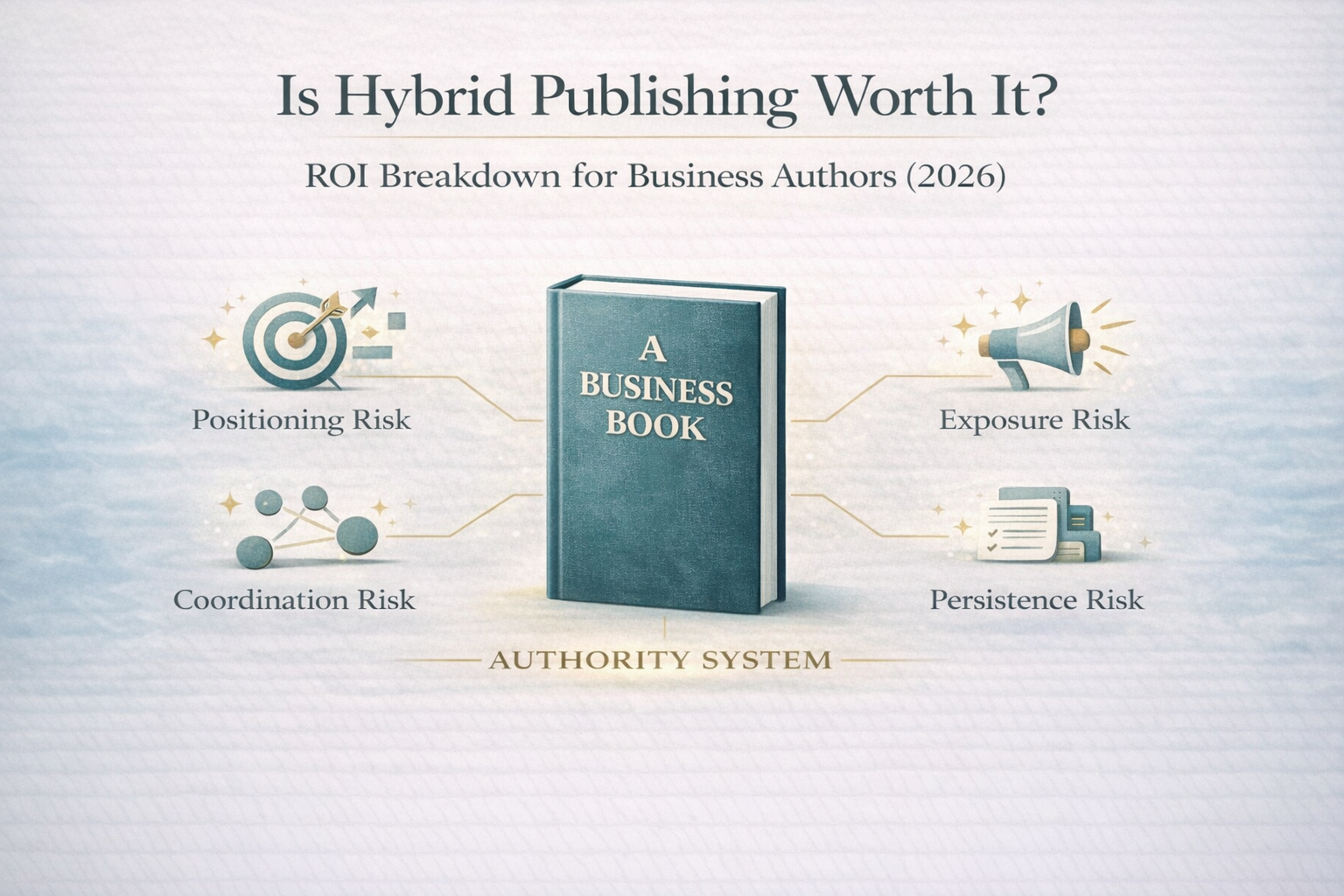
The Authority Risk Model
Positioning Risk
Is the intellectual property clear before exposure?
If positioning is vague, untested, or misaligned with revenue strategy, publishing amplifies the wrong signal.
Hybrid earns ROI when:
- Developmental editorial leadership intervenes early
- Intellectual property is pressure-tested
- Category placement is clarified before launch
If hybrid improves prose but not positioning clarity, authority risk remains intact.
Coordination Risk
Who owns execution when complexity increases?
Publishing requires alignment across editorial, design, metadata, distribution, and launch sequencing.
When accountability is fragmented, strategic drift increases.
Hybrid reduces coordination risk when:
- Workflow is centralized
- Editorial authority is clearly defined
- Launch integration is built into development
If the author remains the general contractor, hybrid may reduce effort, but not structural risk.
Exposure Risk
What happens at launch?
Launch exposure magnifies structure.
If positioning is unclear or audience-building absent, launch accelerates mediocrity.
Hybrid reduces exposure risk when:
- Audience-building begins pre-launch
- Demand is validated before publication
- Messaging aligns with pricing and offer design
If launch is reactive, ROI becomes unpredictable.
Persistence Risk
What survives after publication?
The most overlooked variable in hybrid ROI is durability.
Does the book leave behind:
- Sharpened positioning
- Audience assets
- Repeatable editorial systems
- Strengthened IP defensibility
- Reduced friction for future cycles
If nothing persists beyond the manuscript, hybrid is an expense.
If infrastructure persists, hybrid becomes capital allocation.
The Hybrid Publishing ROI Equation (Explained Simply)
Hybrid publishing is worth it when:
Capital → reduces Positioning + Coordination + Exposure + Persistence risk → strengthens authority → compounds leverage.
If capital only improves polish, authority risk remains.
Polish is visible. Infrastructure compounds.
Not All Hybrid Publishing Models Are Equal: What Actually Drives ROI
“Hybrid publishing” is a label.
Underneath that label are structurally different models.
System-Based Hybrid
- Positioning validated early
- Editorial leadership strategic
- Audience-building integrated before launch
- Coordinated launch execution
- Infrastructure persists beyond publication
Service-Led Hybrid
- Production-focused
- Editorial largely tactical
- Launch addressed post-draft
- Limited long-term system persistence
Self-Publishing
- Full ownership
- Full coordination burden
- High execution variability
ROI depends on whether positioning and audience-building are integrated before launch.
Production improves the artifact.
Infrastructure improves the outcome.
Structural Comparison Matrix
| Variable | System-Based Hybrid | Service-Led Hybrid | Self-Publishing |
| Typical Cost Range | $20k–$75k+ | $15k–$40k | $3k–$15k |
| Who Owns Editorial Judgment | Centralized strategic lead | Production oversight | Author |
| When Positioning Is Validated | Before exposure | Often post-draft | Author-dependent |
| Who Owns Launch Execution | Integrated system | Often author-supported | Author |
| Audience Integration Timing | Pre-launch | Post-production or optional | Author-managed |
| Primary Risk | Author disengagement | Strategic misalignment | Fragmentation |
| Infrastructure Persistence | High | Limited | Variable |
| Likelihood of Leverage Compounding | High | Moderate | Variable |
The only question that matters:
Where does risk sit when execution becomes complex?
When Hybrid Publishing Actually Delivers ROI for Business Authors
Hybrid publishing earns its investment under specific business conditions.
Authority Expansion
Hybrid produces ROI when:
- A proprietary framework is sharpened
- Intellectual property becomes defensible
- Consulting or speaking rates increase
- Positioning is clarified before exposure
If hybrid does not strengthen intellectual clarity, it does not strengthen leverage.
Market Repositioning
Hybrid produces ROI when:
- Entering a new vertical
- Redefining category positioning
- Accelerating credibility in a competitive market
Repositioning without validation increases reputational risk.
Hybrid must intervene at the strategic level, not merely the production level.
Infrastructure Compounding
Hybrid produces ROI when:
- Multiple books are planned
- Courses, licensing, or speaking pathways are integrated
- Audience-building begins before launch—ideally, you build an audience before you write your book.
- Editorial systems improve with each cycle
Completion is a milestone.
Infrastructure is a multiplier.
When Hybrid Publishing Is NOT Worth the Investment
Hybrid rarely justifies its cost when:
- The book has no defined business role
- Positioning is unclear but untested
- Audience-building is absent
- ROI is expected from royalties alone
- The model does not absorb coordination risk
Completing a book is not the same as creating compounding results.
Completion is not compounding.
If the manuscript is the only durable outcome, ROI is fragile.
Why Infrastructure Persistence Is the Most Overlooked ROI Driver
The most underestimated ROI driver is what survives after launch.
Infrastructure includes:
- Refined positioning clarity
- An audience built pre-launch
- A repeatable editorial system
- Strengthened IP defensibility
- Reduced friction for future publishing cycles
If nothing persists beyond the manuscript, ROI becomes transactional.
Hybrid publishing is worth it when it leaves the author structurally stronger than before.
Manuscripts Perspective
Most hybrid publishers optimize for manuscript production.
Modern Authors optimize for authority systems.
That difference reframes the entire category.
Traditional publishing models, whether hybrid or self, are typically organized around production stages:
Write.
Edit.
Design.
Launch.
But serious nonfiction authors are not buying stages.
They are allocating capital to reduce strategic risk.
From a Modern Author lens, publishing is not a service stack.
It is infrastructure design.
The visible book is the artifact.
The invisible system determines whether that artifact compounds.
That system includes:
- Early-stage positioning clarity before exposure
- Editorial leadership that protects intellectual property
- Audience-building integrated during development, not after launch
- Coordinated execution across channels
- Ownership structures that preserve long-term control
Most publishing firms optimize for completion.
Modern Authors optimize for compounding leverage.
That is the real category divide.
Under this lens, hybrid publishing is not inherently superior to self-publishing.
It is superior only when it functions as:
- Risk compression
- System integration
- Authority acceleration
If hybrid behaves like an elevated vendor bundle, it is production with branding.
If hybrid behaves like infrastructure, it becomes capital allocation.
The decision is not:
“Which model is best?”
It is:
“Does this structure strengthen my authority system over time?”
When authors shift from project thinking to system thinking, the hybrid question becomes clearer.
Production answers:
“How do we ship this book?”
Infrastructure answers:
“How does this book increase leverage across cycles?”
The former completes manuscripts.
The latter compounds careers.
Hybrid publishing is worth it when it belongs to the second category.
Buyer Checklist
Before committing, answer these in writing:
- Do I retain 100% IP ownership?
- When is positioning validated, before drafting or after?
- Who owns launch execution?
- Is audience-building integrated before publication?
- What infrastructure persists after this book?
- If I publish again, what compounds?
If answers focus on production tasks, you are buying completion.
If they focus on positioning, coordination, and long-term system strength, you are buying leverage.
If you’re evaluating options, this guide on how to choose a publishing partner breaks down what to look for.
Rule of Thumb
Hybrid publishing earns its cost when capital converts into compounding infrastructure.
If it delivers polish without persistence, it is expensive decoration.
FAQ
Is hybrid publishing better than self-publishing for business authors?
Hybrid publishing can be better when it reduces positioning, coordination, and launch risk. If it only improves production quality, the difference from self-publishing is mostly cost—not outcome.
How much does it cost to self-publish a business book?
Self-publishing typically costs between $3,000 and $15,000 depending on editing, design, and marketing support. However, lower cost often means higher execution responsibility and risk for the author.
Where should you publish a nonfiction business book?
The best publishing path depends on your goals. Business authors focused on authority and revenue often choose models that integrate positioning, audience-building, and launch—not just distribution.
Can you self-publish a book on Amazon and still build authority?
Yes, but distribution alone does not create authority. Without strong positioning, audience-building, and a clear business strategy, publishing on Amazon is unlikely to drive meaningful ROI.
Is a self-published book automatically copyrighted?
Yes. In most countries, your book is protected by copyright as soon as it is created. However, formal registration can strengthen legal protection if disputes arise..