How to Write Like a Thought Leader: The James Clear Principles Framework for Nonfiction Authors

Great Books Aren’t Written — They’re Structured

Most first-time authors start with the wrong question:

“How do I write a great chapter?”

The better question:

“How do I structure my ideas so readers understand, remember, and act on them?”

Thought leaders don’t win because they’re better writers.

They win because their ideas are delivered through a structure that makes those ideas unavoidable.

And James Clear’s Atomic Habits provides one of the cleanest, most repeatable structures modern authors can steal.

At Manuscripts, we’ve studied more than 2,500 nonfiction books inside the Modern Author OS. Across industries, voices, and genres, one pattern keeps showing up:

Readers trust frameworks more than opinions.

Readers remember stories more than arguments.

Readers act when structure makes action simple.

James Clear mastered that blend.

In this guide, you’ll learn exactly how to use Clear’s “Principles Framework” to build chapters that feel polished, persuasive, and inevitable — even if you’re busy, overwhelmed, or unsure how to organize your ideas.

This is the approach we use inside the Modern Author Accelerator and Codex AI to help authors transform scattered expertise into clean, compelling chapters.


Why Readers Trust Principles More Than Advice

Most books fail because they tell people what to do instead of showing how the world works.

Advice feels personal.

Principles feel universal.

James Clear built his book around principles like:

  • Identity drives habits
  • Environment shapes behavior
  • Small improvements compound

These aren’t tips.

These are truths.

A principle is a timeless rule about how something works.

When a reader recognizes it, you get instant credibility.

Why Principles Work So Well in Modern Thought Leadership

They:

  • Create shared language
  • Anchor your frameworks
  • Make your ideas portable
  • Encourage word-of-mouth (“She teaches the principle of X…”)
  • Position you as a category thinker, not an advice-giver

If you want to write like a thought leader, your chapters must translate your expertise into principles — then prove them with stories, data, and frameworks.
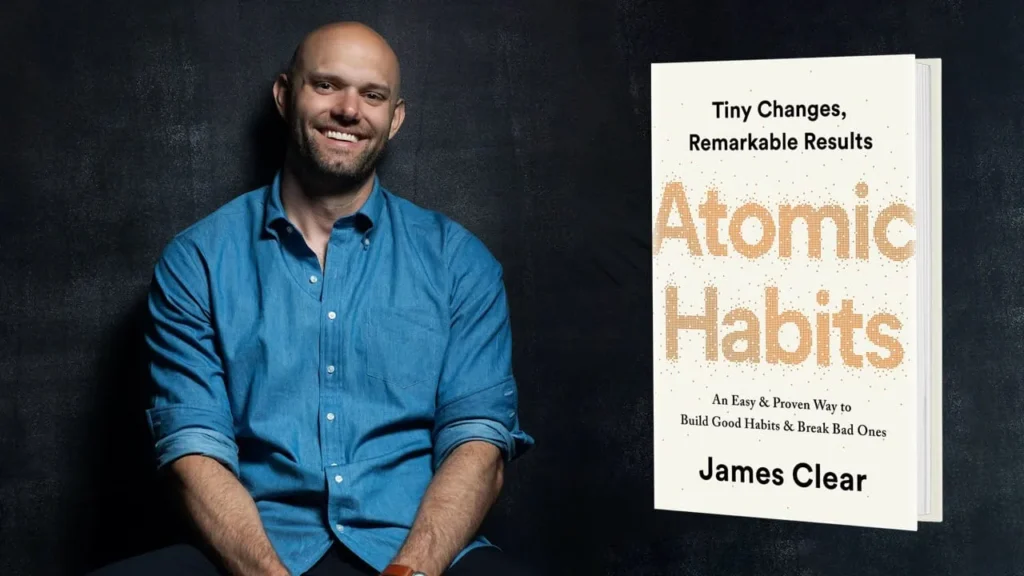

The James Clear Chapter Structure (Reverse Engineered)

We broke down Clear’s chapters across Atomic Habits and found a repeatable flow:

THE CLEAR PRINCIPLES CHAPTER MODEL

  1. Start With a Story A vivid, often surprising story that represents the principle in action.
  2. State the Principle A clear, memorable truth about how the world works.
  3. Explain the Principle Why does this principle matter? What makes it universal?
  4. Demonstrate the Principle Real-world examples, research, case studies, or analogies.
  5. Introduce a Framework A simple, visualizable system or model that operationalizes the principle.
  6. Apply the Framework Show readers what to do and how to do it.
  7. End With a Memorable Line or Punchline A repeatable idea that readers can’t forget.

This structure is extremely friendly for:

  • Busy authors
  • Business leaders
  • Consultants
  • Coaches
  • Creators
  • Anyone trying to turn expertise into IP

It reduces blank-page stress and gives your reader cognitive grip.


Build Your Chapter Around One Core Principle

Every great chapter answers one question:

“What is the single principle this chapter proves?”

If your chapter has three ideas, it’s confusing.

If it has one idea, it’s powerful.

Your principle must be:

  • True (backed by research or lived experience)
  • Simple (plain language)
  • Useful (changes behavior or perspective)
  • Memorable (easy to teach)

Examples:

  • “People don’t rise to the level of their goals. They fall to the level of their systems.”
  • “Clarity creates courage.”
  • “Positioning is what you own in the mind, not what you say in the pitch.”

Inside Codex, this is where we extract:

  • Repeated beliefs
  • Thematic patterns
  • Contrasts
  • Identity statements
  • Core insights

And then synthesize them into a clean principle.


Start With a Story (Your Anchor)

Clear opens nearly every chapter with a surprising or emotional story.

Why?

Because stories create cognitive hooks.

The story makes the principle stick.

Your story must do at least one of these:

  • Illustrate the principle in action
  • Represent a transformation
  • Set up the problem the reader is facing
  • Create tension or curiosity
  • Build trust through vulnerability

Examples from Clear:

  • The British cycling team transformation
  • The Japanese train station cleaning ritual
  • The Seinfeld chain method

Stories = stickiness.

Principles = clarity.

Frameworks = action.

That combination creates bestseller energy.


Demonstrate the Principle With Multiple Angles

James Clear doesn’t just state a principle and move on.

He proves it three ways:

1. Research or data

Gives credibility.

2. Examples or case studies

Makes it relatable.

3. Metaphors or analogies

Makes it memorable.

When we work with authors, we call this the Evidence Bundle.

One principle → three types of proof.

This is where the Manuscripts methodology shines:

we teach authors how to gather stories, turn them into data, and feed them into Codex so that each chapter writes itself.


Turn Your Principle Into a Framework

This is where most first-time authors fall short.

They give great stories.

They explain great ideas.

They forget to give readers a system.

James Clear always does.

He turns principles into:

  • 4 Laws
  • Systems
  • Rules
  • Models
  • Step-by-step processes

A framework moves readers from “I understand” to “I can use this.”

For your book:

  • Give every chapter one framework
  • Make it visual
  • Use 3–5 steps (cognitively optimal)
  • Tie each step back to the principle

This is also how you turn your book into:

  • A keynote talk
  • A workshop
  • A course
  • A coaching program
  • An enterprise training system

Frameworks = monetization.


Close With a Punchline or Insight They Can’t Forget

Clear ends each chapter with a sharp, memorable line.

These lines often end up:

  • Quoted
  • Shared
  • Highlighted
  • Used in talks
  • Referenced in articles

Examples:

  • “You do not rise to the level of your goals. You fall to the level of your systems.”
  • “Every action you take is a vote for the type of person you wish to become.”

Your closing line should be:

  • Short
  • True
  • Repeatable
  • Aligned with the principle

This becomes your intellectual signature.


Your Chapter Template (Manuscripts Version)

Here’s the Manuscripts + James Clear hybrid chapter template:


CHAPTER TITLE (Benefit + Insight)

1. Opening Story

One vivid, emotional story that sets up the idea.

2. State the Core Principle

One sentence.

3. Explain the Principle

Why it matters. Why it’s universal.

4. Demonstrate the Principle

  • Research
  • Case studies
  • Examples
  • Metaphors

5. Introduce the Framework

3–5 steps.

6. Apply the Framework

Practical, step-by-step implementation.

7. Close With a Punchline

One memorable, tweet-length idea.


Feed this to Codex and you’ll get a chapter preview in 20 seconds.


Why This Structure Works for Busy Authors

If you’re a busy modern author, you need structure that creates speed.

This model gives you:

  • A predictable chapter flow
  • A way to write in 60–90 minute bursts
  • A framework that turns scattered notes into clear structure
  • A repeatable process you can use 10–12 times
  • A blueprint for repurposing every chapter into content

This is why our Accelerator authors can write high-quality drafts in 8–14 weeks even with full-time jobs.


How Codex Accelerates This Entire Process

Codex turns the James Clear method into an automated outline generator.

Upload a transcript, notes, or a research dump and Codex will:

  • Extract potential principles
  • Map your stories to principles
  • Identify gaps
  • Cluster examples
  • Propose 3–5 frameworks
  • Generate chapter outlines
  • Rewrite principles in cleaner language
  • Produce chapter summaries, headlines, and social posts

This takes authors from overwhelm to momentum fast.


Bringing It All Together

Writing like a thought leader is not about being a genius.

It’s about having a structure that elevates your ideas.

James Clear gave modern authors one of the most effective chapter models in nonfiction.

Use it.

Adapt it.

Make it your own.

This framework, combined with Codex and the Modern Author OS, gives you everything you need to write chapters that are clear, persuasive, memorable, and actionable.

If you want to write like a thought leader, build chapters around principles.

Principles build books.

Books build opportunities.

Opportunities build a platform.


Call to Action

If you want help using the James Clear Principles Framework to write your book, schedule a free strategy call with Manuscripts.

We’ll help you:

  • Identify your core principles
  • Build your frameworks
  • Structure your chapters
  • Use Codex to accelerate your draft
  • Build your platform while writing
  • Turn your book into speaking, clients, and business growth

Schedule Your Free Strategy Call


About the Author

Eric Koester is an award-winning entrepreneurship professor at Georgetown University, bestselling author, and founder of Manuscripts, the Modern Author OS used by more than 3,000 authors. His work has helped creators turn ideas into books, books into brands, and brands into scalable businesses.

About Manuscripts

Manuscripts is the leading full-service publishing partner for modern nonfiction authors. We help founders, executives, coaches, and experts turn their books into growth engines, through positioning, coaching, developmental editing, design, AI-enhanced writing tools, and strategic launch systems. Manuscripts authors have sold thousands of books, booked paid speaking gigs, landed media features, and generated millions in business from their IP.

Work With Us

If you’re writing a book you want to matter, let’s map out your Modern Author Plan.

👉 Schedule a Modern Author Strategy Session → https://write.manuscripts.com/maa-web

👉 Explore Manuscripts Publishing Services → https://manuscripts.com/publish-with-us/

👉 See Modern Author Success Stories → https://manuscripts.com/authors/

Modern Author Resources

  • How to Write a Book if You’re Busy
  • Modern Ghostwriting for Nonfiction Authors
  • AI Tools for Authors in 2026
  • How to Build an Audience Before You Write Your Book
  • The Evergreen Launch System for Modern Authors

Powered by Codex: The Modern Author AI Tool

How to Write and Launch a Book in 2025 (Without Feeling Afraid)

Writing a book seems scary. And this fear triggers 4 major mistakes. How to write and launch a book in 2025 (without feeling afraid)?

The 4 most common mistakes:

  1. Writing alone
  2. Forcing a structure
  3. Unique knowledge points
  4. Focusing on the Big Numbers
Let’s break them down:

1) Writing Alone

The first thing I’ll tell you: Most people think writing a book is an individual endeavor. It’s not. The reality? When you talk to the most successful authors, they all start by talking about other people.
  • How they worked with a group.
  • How they collaborated
  • How they had a ton of help
And this is what I always tell people: Writing is NOT something you do alone. You do the typing yourself, yes. But you DON’T write a book as an individual. No… It’s a collaborative effort.

2) Forcing a Structure.

This is a big one for most people. They think they need: • a table of contents • perfect structure • rigid outlines All this stuff, before they ever start. But I would flip that around. Analogy:
“You start this process with a compass, not a map”
And when I had the chance to interview Daniel Pink (who also happens to be my neighbor), he shared something interesting: He starts with 2 things: 1. A notepad 2. A list of questions And then he thinks about who he can talk to about those questions. As I said earlier… Books are not to be written alone!

3. Unique Knowledge Points

This is for my non-fiction writers. I studied 150+ best sellers and found this: Stories account for 80% of their written content. NOT unique knowledge points. So if you want to write an exceptional book: - Identify - Teach - Tell All through storytelling It’s the proven formula for success.

4. Focusing on Big # ’s

People often worry:
“Is my book going to sell 1,000,000 copies?”
And that’s not the best mindset. Here’s why: Books are sold via word of mouth. You want to find your first 200 fans and friends, and have them help spread the word. It happens in phases. And that’s a good thing ( I promise ).

The 4 major mistakes authors make:

1. Writing Alone 2. Forcing a structure 3. Unique Knowledge Points 4. Focusing on Big Numbers So let's break this cycle and utilize a community-driven approach for your next book project.

How to Get Rid of Imposter Syndrome & Validate Your Voice

Imposter syndrome means extinction for most modern authors. And it's a shame.

Steal my 3 steps to validate your voice

I'll be honest: I hate the term "imposter syndrome." It’s almost as if you're afflicted with a disease—shunned by society—destined to live out your days in a dark forest. It plagues so many authors.

These 3 steps are the cure:

  • Step 1: Identify Your "Who"
  • Step 2: Create a Pact
  • Step 3: Gather Feedback
Let's regain your self-confidence. I know it's in there...

Step 1: Identify Your "Who."

Engrain this in your mind: You're NOT writing for everyone. When you accept the fact that you can't please every person on the planet, imposter syndrome fades. Normalize selective sharing. You'll also need some accountability. There are 2 types: 1. Professional accountability 2. Peer accountability Professional, you pay for: - Someone from a publisher - A writing consultant - Editors A peer can be a friend.

Step 2: Create a Pact.

The reality is, most writers think in word count. Bad idea. Try thinking in terms of time. But beware of overestimation. Research shows that we often overestimate the amount of work we'll need to do. This overestimation problem manifests as a disappointment problem. Here's an example of a time pact: “I’ve got two hours blocked off to write this week. Can I send you something to read from that?” Here's what you just accomplished:
  • You've limited your feedback loop.
  • You've scoped your deliverable.
  • You've set aside some time.
This loose commitment (pact) will increase your chances of completion. Give it a shot.

Step 3: Gather Feedback.

Here's what you don't want: Accidentally make your imposter syndrome worse. Make sure to ask for feedback in the way you'd like to receive it. Here's how... You probably don't want them to bloody up your book with a rampant red pen.
  • Tell them not to change the text
  • Ask for 1 or 2 things they liked
  • And what you can improve
Then you can go ahead and make changes you think make sense. Bye-bye imposter syndrome!

Depth Over Frequency for Growing Your Brand

If you're interested in growing your brand or amplifying your voice, here's what we found in the research.

Aim for depth over frequency.

For my latest book, I researched over 6,000 individuals named to the Forbes 30 under 30. I wanted to see what stood out about them. It wasn't the schools they attended, the graduate degrees they help, or the companies they worked at. It wasn't even the companies they started.
Over 85% of them had a "Creation Event" -- a substantial, public project that they used to demonstrate their expertise, credibility, curiosity, and competence.

Nearly all of them 'went deep' on something outside of their job or work.

We found 9 creation events among these individuals, including:
  • hosted an event series or conference
  • hosted a podcast
  • created a video series
  • organized a concert or exhibit
  • published original research
  • wrote a book
  If you're looking for a path to elevate your voice or enhance your personal or business brand, focus on depth over frequency. OR, start with depth, and then add frequency based on the depth. Invest in a Creation Event. The best investment is an investment in your own growth. What's the most impactful creation event in your career/life?
5 Tips to Find Your Writing Focus

Writing can be a painstaking process. And after launching 2,000+ authors and books of my own...

5 tips to find your writing focus:

With steadfast focus, you're unstoppable.

Steal my 5 tips:

1. The beautiful art of freewriting 2. Always write in small chunks 3. Find yourself a writing rival 4. Find stress-free activities 5. Discover a community Eggcellent, let's crack the shell. Shall we?

1) The Beautiful Art of Freewriting.

Set a timer for 10 minutes and write whatever comes to mind. Transfer all your: - Musings - Emotions - Negativity Onto the paper, or through the keyboard.

2) Always Write in Small Chunks.

This is a PSA for my modern authors... You don't have to: - Write 10,000 words at once - Put off your obligations - Pull all-nighters Try to write in smaller chunks, but do it more frequently.

3) Find Yourself a Writing Rival.

You guys have heard me say this before: "Writing is NOT something you do alone." Find a fellow author, then: - Challenge each other - Set some nice goals - Utilize rewards

4) Find Stress-Free Activities.

You have SO many options: - Walk - Do yoga - Lift weights - Listen to music Find something to relax your mind.

5) Discover a Community.

With a group of like-minded individuals, you increase the likelihood of (actually) sitting down to write. Not only that but: - Accomplishing your goals - Improving your craft - Fulfilling dreams That's what we're after, isn't it? Folks, this chapter has come to a close. What's your secret to find your writing focus?

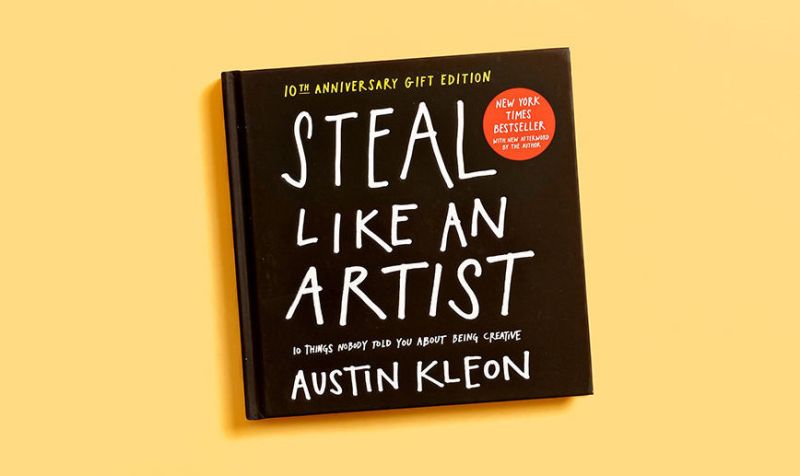
How To Leverage Creativity in Writing: Insights From Austin Kleon

Pablo Picasso once said:
“Good artists borrow, great artists steal.”
So I sat down with Austin Kleon, author of “Steal Like An Artist” to talk about creativity and writing.

These are the 10 best takeaways:

1) Exploring and Collecting.

Having a system for exploring and collecting ideas is vital. The best creators: • Explore the world • Capture its essence • And share the result

2) Input to Output Ratio.

Inputs: • Reading • Learning • Inquiring Outputs: • Writing • Ideating • Creating The ratio should be at least 1:1 If not 2:1, input to output.

3) Thinking in Verbs, Not Nouns.

Don't become too attached to job titles or nouns. Instead, focus on the verbs. The actions you take. The stuff you really enjoy. The things others respond to.

4) Authenticity and Frequency.

Authenticity and consistency are KEY. Try to set: • Goals • Deadlines • Aspirations This will help maintain frequency which will turn into consistency.

5) The Role of the Reader.

A book comes alive when the reader picks it up. The reader's interpretation and engagement with the work is a crucial part of the creative process. So pour out your heart and soul.

6) Making Yourself Interesting.

To create interesting work, you need to be an interesting person. That doesn't mean: • Outlandish • Eccentric • Flashy Just be genuinely interested in the world. And make it interesting to others.

7) The Importance of Fun.

Writing should be fun. If it feels like work, not play, it's hard for the reader to enjoy it. They feel what you feel. (That's the beauty of writing).

8) Stealing Like an Artist.

This doesn't mean plagiarizing. Rather, you should draw inspiration from existing works and add your own spin. Everything's already been said. But maybe not by you...

9) The Power of Visuals.

Austin Kleon's creative process often involves visuals. When there are more pictures than words, creativity thrives. As they say: "A picture is worth 1,000 words."

10) The Value of Notebooks.

As a writer, you NEED a notebook. Not only will it help capture thoughts and ideas, but you can also revisit them. You'll see your evolution over time. How do you cultivate creativity in your writing?

How Compassionate Rigor Changes Our Work Ethic

"I'm not ready yet." These are two words you need to be ready for anything new. Compassionate Rigor. Our fears lie to us: "I don't have the time." "I don't have the right idea." "I don't have the money to do that." You don't need to be "ready." You need Compassionate Rigor: "I will set milestones, checkpoints, and reviews, not goals." "I will set aside money every week to invest in myself." "I will join others to share our journeys." "I will set aside make the time." Stop beating yourself up for what you don't have. Young author with compassionate rigor Compassionate rigor is a commitment to yourself, to milestones, to objectives, to learnings, and to time... -- Rigor in your commitment, your investment, and seeking accountability. -- Compassion in your timelines, deadlines, iterations, coaching, and support. You not going to be ready... you'll get ready by doing things with compassionate rigor. Demand this in yourself and with everyone you involve in your journey.

Here's the good part: We launch authors, not books.

If being 'not ready' has held you back from writing your book... let's schedule a call and talk through how to leverage the power of Compassionate Rigor this summer with our next author community. You'll learn:
  • How to develop the book into workshops, keynotes, coaching, and more
  • How to use category design to make your book unique and create word of mouth
  • Why we don't write books, but build books
  • How to leverage the power of fans to market your book

JOIN OUR

MODERN AUTHOR ACCELERATOR PROGRAM Apply by July 1st.

See how the power of weekly coaching and a community of peer authors can help you develop and announce your book in the next 6 months -- all through the power of Compassionate Rigor.

Making Time to Write: 4 Steps For Busy Professionals to Create Books that Elevate Their Voices

"When do you find time to write?" You don't find time... you *make* time.

4 steps I teach busy professionals to make time to create books that elevate their voices

The people who most need and want to write a book tend to be the people who have the busiest schedules -- executive coaches, business owners, consultants, and C-suite executives. They know a book will be powerful -- most have tried in the past -- but often it's time that gets in the way.
  1. Trying a book in the past and it not working isn't signal you're not motivated. Trust me, if that were the case I'd be the poster child. It's usually a signal that you don't have a system.
  2. Writing a book is *not* like what you see in the movies. You don't go off to a cabin and spend six months at a typewriter... eventually emerging as a shell of yourself but with a manuscript. You don't write a book, you build a book. And that's the key mindset.
  3. You don't find time to write a book. You make it. Funny enough, we ran a test in our community about people who were going to use a "summer off" to write... that group who had more downtime were *less* likely to finish their manuscript on schedule. It's not about having oodles of free time. It's about having dedicated time.
  4. Making time requires two things: (a) your calendar; and (b) accountability to others. For most authors, I recommend 4-6 hours a week of calendared time... but the key is to share that calendaring with others. Could be your spouse, your business partner, your editor, or a writing friend. Has to be on your calendar and shared.
It's simple, and that's why it works.
"I'm proof that your 4 steps work. After 15 months, a retired “bean counter” is a proud published author of a 5-star book, called Checkmate!? - Greg Davis, Author of "CHECKMATE"
  Most authors struggle not because they don't have a great book idea or the motivation... they struggle without a process and system to make time. Do that, and I've seen 2,000+ people succeed in their books. It's the only way I've been able to do it too... Modern Author Accelerator Testimonial I'm starting my next book this summer as a part of the Modern Author Accelerator powered by Manuscripts. Why now? My summers are some of my busiest times -- I teach two MBA courses, I have a new cohort of authors, and I have four workshops/mini-courses -- plus I've got three hilarious girls to run around with to camps and summer fun. But I'm going to finish a draft manuscript and announce this new book in November. How? I am making time: Mondays, Wednesdays, and Fridays from 8:15 to 10:00 am ET are my writing time. Some days I miss, but most days I hold myself accountable (plus, I have shared this plan with my editor, my wife, and my fellow authors). That's part of the #NeverWriteAlone philosophy. And that's how I'll write a mediocre first draft that becomes an amazing book. If you're looking for a little summer accountability, shoot me a note, and love to have you join our summer group -- we're all announcing our books this November and then the fun begins. Ready to make time for something important?

Apply for Summer Modern Author Accelerator Program

From a Book to the Stage: Four Strategies Authors Can Leverage to Get Booked for More Speaking Gigs

If you want to get paid to speak, you need social proof. I’ve tested four strategies. 

Why Does Public Speaking Matter (Especially Today)?

We consume a lot of content today.  Some content is for entertainment, but much of what people consume is to help us learn, improve, or grow.   If you want to cut through that noise, you need to capture attention. And one of the best ways to capture attention is to stand in front of an audience and speak directly to them You may have the greatest shot in those few moments to truly stand out. If you're a coach, consultant, business owner, or thought leader, you need attention for more clients, customers, and business opportunities.  Personally, speaking has created some of my warmest relationships and can be quite profitable.  I've spoken in some amazing places -- the White House, UN, Google, Microsoft, GE, baseball stadiums, etc. -- and some funky places like bars, basement offices, and high schools.  Quite a few have been on Zoom too... which can be great too.  At the end of the day, regardless of the venue, it's a business strategy, and I look at it as marketing.  It's led to clients, customers, and more paid speaking. It’s high-value attention.   But it's hard to break into the game... people often ask me about speaker bureaus or consultants.  Frankly, to break in... you'll have to do it yourself (then maybe those can help).  You need a social proof strategy.

It’s Not What You Say, But What the Audience Will Hear

One of the biggest fallacies about public speaking is you just need to have a great speech.  I spoke to one of the individuals responsible for booking talent for TED and TEDx talks, and what he told me surprised me:
“We want ideas that spread, not just inspiring stories.  We’re not in the business of promoting anecdotes.”
You need social proof:
  • Social proof of your idea isn’t just an inspiring anecdote
  • Social proof that your idea can move an audience
  • Social proof that your idea is new and forward-looking
  • And you can be strategic in creating it and leveraging it.
Modern Author Accelerator Program

Social Proof is Not One thing; It’s Multiple Things That Build on One Another

Social proof isn’t a single thing – it’s not your published book, it’s not your TEDx talk, it’s not your article, and it’s not one testimonial.  Social proof is the story you tell (or show) about why an audience would be moved by what you have to say, share, and teach. How you tell (and show) that story is the key to getting you booked for more speaking opportunities.   These four things- usually in combination- prove you're worth booking.

Here are the four strategies I've seen work:

  1. Thought Leadership. This is the most important -- do you have an 'unconventional' insight backed up by evidence (your research, interviews, data)?  Things that demonstrate thought leadership are a book or upcoming book, a research-driven article in a publication like HBR or Forbes, a TEDx talk, or a badass interview (usually on a stage). Without this nailed, it's an uphill battle.
  1. Testimonials and reviews.  This isn't about the 'fame' of the person but the relevancy to the audience. More variety you can customize the better.
  1. Social Media Engagement. Do you think your posts create conversations?  Will your talk spark similar conversations IRL?
  1. Past speaking engagements. I put this last because people overrate a 'speaker reel'... it helps (of course). Yes, it helps, but today having 1-3 with some podcast interviews, YouTube videos, etc., can be more powerful.

Design Your Strategy to Improve Each Dimension of Social Proof.

It’s a journey – not a destination I look at my own growth as a speaker over the past few years and realize some of today’s opportunities wouldn’t have been possible two or three years ago.   Could you design a strategy for your social proof?  Most of today's best thought leader speakers create social proof by being
  • (a) unconventional (but evidence-backed);
  • (b) relevant;
  • (c) engaging; and
  • (d) compelling. 
  Remember... you're not competing with established thought leaders for speaking slots... your goal is to position yourself as the next thought leader. How? One of my favorite ways to strategize on this is to figure out how to be a "poor man's" _____.    Sure, you're not Brene Brown, Simon Sinek, or David Goggins (yet)... but use 1-4 above to help showcase where you could offer something those more prominent names don't.  Consider creating a grid and scoring some of the names you aspire to be like – then score yourself (but be kind).  What are the areas you can improve in… as you get more evidence and proof points, update your score. Review yourself as a speaker on those four dimensions -- and update as you grow. 

Why Category-Defining Books Start With a Question (Hint: You Don’t Need to Be an Expert Before You Write a Book)

“Why would anyone listen to me?” “I don’t know enough about the topic.” “Do you think I need to get a Ph.D. first?”
Expertise. It’s a common misconception about writing a great book. So the thinking goes, you become an expert and then just tell people how. But the reality is quite the opposite.   I asked author Dan Pink about the origins of his recent book When: The Scientific Secrets of Perfect Timing, and his answer surprised me. “That book had its genesis in this office. In an attempt to answer how I should approach my work.” A question he wanted to answer for himself. I asked Arianna Huffington why she wrote Thrive: Third Metric to Redefining Success and Creating a Life of Well-Being, Wisdom, and Wonder. “I collapsed from exhaustion and burnout in 2007, and started studying the whole phenomenon of burnout, covering a lot of it in the Huffington Post that I was running at the time. And then I started wanting to write about it. So, that's how Thrive came about it. It was really my new passion.” A question she wanted to answer for herself. Even my recent book Super Mentors began with a question: “Why wasn’t I a very effective mentor?” And the resulting work and book taught me something compelling that I shared with others through the book. This a question I wanted to answer for myself. None of us were experts, but we became experts by writing these books. Great books begin with a question.  But how do you find yours? * * * First, some wrong questions often clog the potential book writer’s mind:
  • Is it unique?
  • Will it sell?
  • Can I finish?
Those are different from the kinds of questions to fixate on. Sure, they are concerns, but truthfully they are much less relevant when you have a driving question.

Find Your Driving Question

Great books are based on a type of question I call your driving question  Driving questions are deeply personal, cross-cutting to numerous aspects of your life, and they nag at you often through an emotional thread.   It’s something that bugs you.  
  • Why can’t I . . . 
  • How come I . . . 
  • What’s stopping me from . . .
  • Why don’t we . . .
  • How come they won’t . . .
For Dan Pink, it was when he should be working to maximize his happiness, health, and success. For Arianna, it was how she should take care of herself to maximize her long-term well-being. For me, it was how to make a difference with others when I tried to help.   The way I summarize this is to ask yourself: What annoys you – and no matter what you’ve read, watched, heard, or done just doesn’t seem to fix it for you? That is a driving question.   What’s vital about driving questions is that conventional wisdom – what most people think or believe – is just unsatisfactory to you.   Sure, there may be answers from experts, research, and other places. But it’s unsatisfactory for you. You’re annoyed that you can’t find something that works or is satisfying for you.   Congratulations. You’ve got your driving question.

Is It Worth Finding Answers to Your Driving Question

Finding a question is relatively easy. Finding a driving question is more challenging. But the real trick is deciding something different: Is it worth finding answers to your driving question? Most likely, answers exist to this question. Books have been written. Podcast interviews are out there. Blog posts are plentiful.   Don’t expect to be the only one thinking about your driving question. Driving questions likely drive others too. That’s a good sign people are trying to answer it. But you’re on the right track if you find the answers unsatisfactory, incomplete, or too general. Remember, Dan wasn’t the first person or only person to write about the power of timing, luck, time management, or similar themes. There were dozens and dozens of books on wellness, sleep, purpose, etc., before Arianna wrote her book. And mentorship is one of the most covered subjects on the planet.   But none of them were satisfying, complete, or specific to us. Something was missing.   Remember, driving questions are deeply personal, and that’s part of what makes books special and unique:
  • Dan Pink was a modern, independent worker. As an author, he doesn’t punch a clock. Many books about time management or understanding timing were built when we didn’t control our schedules. He needed a unique and updated view for people like him. 
  • Arianna wasn’t a scientist, but she’d risen to fame and simply couldn’t go off in the wilderness and meditate to find her wellness. She needed to examine it for busy and ambitious professionals who wanted more. 
  • I was exploring modern mentorship in the digital era where the internet had changed access to advice and information. Nothing I’d read offered that modern look. 
But how will you know if it is worth finding answers to your driving question? I suggest you answer two questions:
  1. Is it something I’m willing to spend the next year going deeper into for myself?
  2. Is it something I’m willing to teach to others like me?
If your answer is yes to both questions, then you have checked a very important box in the book process:  This is a driving question worth finding answers to.

Where to Find Help Answering Your Driving Question

This is where many aspiring authors get stuck – answering your driving question isn’t easy or straightforward.   The answers will be nonlinear, more like a treasure hunt than a path.   And this is where the process is critical: You don’t look for an answer. You look for people who can contribute to your answer. This is critical – you should assume there is no answer. Dan Pink shared that he took a yellow notepad and began creating a list of people he wanted to learn from or talk to to answer his question.   Assume every expert will offer you something helpful, but it’ll be unsatisfactory, incomplete, or too general. There is no one magic TED Talk, book, or framework that answers your driving question. But they will have helpful contributions. What is a contribution? According to our good friend Webster (the dictionary), it’s when you give (something) to help achieve or provide something. For an aspiring author, the “something” here differs from what people usually expect from hunting for answers. Hunt for stories. I recently wrote a longer post about the hunt for stories called "Master Story Gathering: Four Steps to Research Story Ideas for Any Nonfiction Book". Especially early in your journey, you’re looking for contributions through the stories of others.  

Share Answers to Your Driving Question

Early in your writing journey, keep your writing short – usually, 50-250 word snippets that summarize the story from a podcast, an experience in your own life, a TED Talk, an interview you did, or just something random you thought of.  These smaller answers – contributions – are what will guide you toward answers that are:
  • More satisfactory
  • More complete
  • More specific
Remember, your book isn’t the only answer out there…  I can't guarantee that reading one book will change your life. But I can guarantee that writing one will. Through that process, you’ll answer your driving question,  and have something to share and teach others who also feel like you. * * * Most of the best books I’ve read didn’t start from a place of expertise; they started from a place of curiosity. Find your driving question and commit to answering it yourself and sharing it with others through a book. So, what’s your driving question?
Eric Koester is the founder Manuscripts, LLC, a b-corporation whose mission is to inspire, teach and support tomorrow’s creators — authors, podcasters, speakers, entrepreneurs, corporate innovators and course builders. Through his work he’s coached nearly 1,000 first-time creators. He is also a Professor of Entrepreneurship & Innovation at Georgetown University and the school’s only two-time entrepreneurship professor of the year, faculty at Growth University, and the executive director of the Intrapreneur Institute, which researches, trains and develops future innovation leaders.