MANUSCRIPTSMANUSCRIPTS
  • Write Your Book
  • Publish With Us
  • Book Launches
  • Blog
SCHEDULE A CALL

Six Core Actions to Define Your Book Category Before You Write

To Make a Book That Changes the World (or your corner of it), You Must Reject a Current Premise.

Why do certain books spread while others languish in obscurity?   It’s the question most authors wrestle with at the start of their book journey — and a question that often causes paralysis among writers. You could argue that it’s the writing, it’s the author, it’s the topic, it’s the timing, or it’s the combination of all of these that cause a book to spread.   We believe books that spread nearly all define a new category. The trick is designing a book that defines yours (don’t worry, you’ll have help!)

What is Category Design?

Category design is an emerging business strategy companies and individuals have employed to stand out and gain market share (rapidly) in large, crowded, competitive markets. Often confused with ‘going after a niche,’ category design is best described as a holistic approach to examine at a narrow initial opportunity through a brand’s products, culture, storytelling, and business model. By beginning with a narrow initial opportunity, category designers can quickly grab market share and expand rapidly. Per Wikipedia, Category design was first proposed in the book Play Bigger.  The book lays out a justification for why category creation is an important strategy and includes a step-by-step guide to applying design thinking to category creation:
  • discovering and defining a category problem,
  • creating a clear story (called a point-of-view) that explains and sells the category idea,
  • defining a category blueprint,
  • driving the category strategy across a company's stakeholders (mobilization),
  • shaping customers' thinking (lightning strikes).
The concepts tie back into recent writings about how our brains work, particularly cognitive biases as described by Daniel Kahneman. The good category takes advantage of cognitive biases such as the choice supportive bias and group think bias. An example of category design in new products is Dr. Squatch soap and men's products. Seeing a gap in the market for men’s soap, Dr. Squatch has built a rapidly growing, multi-million dollar business by designing a category around soap for men. They successfully built their business with storytelling, hyper-targeted internet advertising, and an expanding product suite of extension products. This approach of designing a category has led other mass-market soap companies to ‘follow’ their lead with new products. Dr. Squatch did not ‘go after a niche’ (as it did not necessarily exist), but they holistically developed a category around an underserved or underappreciated market. Dr. Squatch defined a new category by rejecting the current premise that soap is soap.  In particular, category design is critical because it enables an upstart to stand out in a relatively crowded market. What we know from category design in business/innovation is that there are usually a set of ‘winners’ in newly defined categories (the ‘law of six to ten’). Wikipedia goes on to say: Data research shows that "category kings" (companies that dominate a market category) that go public when they are between six and ten years old create most of the value among all VC-funded tech companies. Companies that go public sooner than six years old often lose value; companies that IPO after ten years old create little value for shareholders. The reason is thought to be that categories take around six years to develop, and most of a category's growth happens in that six to ten year timeframe. After ten years, a category is established and growth slows, so share prices level off. This was discussed in a Harvard Business Review article titled "How Unicorns Grow."

What Is a Book Category?

First, let’s talk about what is not a Book Category: the category or subcategory your book is listed under on Amazon or shelved under in a bookstore. While those are categories , . . they are not designed categories. We define your book’s designed category as a niche the author owns (or attempts to own). If this were an Amazon category, you’d be the only book in it (or one of a small handful) . . .and if it were a category in the bookstore, yours would be the only one on the shelf (or one of a very few).   Second, the best way to think about defining a book category is to fill a meaningful gap in the knowledge market. Books that offer an unconventional, underappreciated, or new approach to a substantial problem can define a new category of thinking. Category-defining books often elicit a reaction from their early fans of “I always thought that too . . .” We typically find books that define new categories are based on two distinct approaches:
  • Defining a type of person
  • Defining a type of action

Type of Person

Category-defining books often describe a new type of person, a person who your readers may aspire to be or become. Examples include: Originals by Adam Grant; Outliers by Malcolm Gladwell; Untamed and Love Warrior by Glennon Doyle; and even the Hunger Games series by Suzanne Collins defined a new fictional character persona through Katniss Everdeen (the pure heroine).

Type of Action

Category-defining books often describe a new type of action, an action your readers may aspire to do or do more. Examples include: Start with Why by Simon Sinek; Lean In by Sheryl Sandberg, Eat, Pray, Love by Elizabeth Gilbert; Daring Greatly by Brene Brown; Atomic Habits by James Clear; and even novels like Ready Player One by Ernest Cline defined a new action in virtual reality, and They Both Die at the End by Adam Silvera defined a new YA story genre about living vs. dying.   To be clear, these are not the only reasons these books did well, but by defining a new category it enables them to capture an underserved niche quickly. Most of these books mentioned above have had ‘fast followers’ of other books similarly themed and designed to capture the momentum they created.  

How Can You Design a Book Category?

To make a book that defines a new category, you must reject a current premise. We define this process as establishing the book’s tension statement. A tension statement is how your book will reject conventional wisdom. It’s a challenging proposition, but also core to defining a new category.  For example, Dr. Squatch had to reject the proposition or premise that soap is soap is soap. Instead, Dr. Squatch has made every aspect of its advertising, marketing, branding, and storytelling around the idea that modern men should reject the premise that soap is soap (if you watch their advertising, they go after body wash, non-masculine scents, and chemicals).   Similarly, Simon Sinek rejected that you start with how, Adam Grant rejected that originals are risk takers, Brene Brown rejected that courage is rejecting fear, and even Suzanne Collins rejected that young heroines need saving in Hunger Games. That’s why the core of designing a book category is explicitly attacking conventional wisdom:

Nearly everyone thinks or believes _____.

And in fact _____.

But based on my research, experience, hunch, and interviews, I believe _____.

I saw this in my own life when ______.

And you even see this in the experiences of ____ and _____.

For example, in Super Mentors (Koester, 2022), the tension statement is that “nearly everyone thinks you need a mentor, but I’ve found you actually need a project.” In Pennymores (Koester, 2022), the tension statement is that “nearly everyone thinks you cast magic with a wand, but in Pennymores, you write magic with a quill.”

How Does the Positioning Process Help You to Define Your Book Category?

I find there are six important steps in the process of defining and validating your book’s category.  
  1. Define your tension statement, and test it through conversations and sharing elements of the tension statement on social media for reactions.
  2. Research stories of others who ‘fit your category.' Through that process, you'll work to identify 20-30 stories from podcasts, interviews, TED Talks, panels, and articles of individuals who also reject convention and operate in this unconventional manner.
  3. Interview individuals who ‘fit your category.’ You’ll learn from conversations and discussions with experts in the field.
  4. Write personal stories that align to the unconventional aspect of your own story.
  5. Write your introduction to make the case for this new category.
  6. Define the sub-elements of the category through your working Table of Contents.
The important thing about defining a category for your book is recognizing that it is not about being completely ‘unique’ — meaning just because others are offering a similar thought process or thinking. It’s not about finding a niche — looking to tap into a specific audience. Defining a category for your book involves rejecting a current premise, and making the case why you’ve spotted this trend early, and soon others will see this too. You don’t need to be the only; you need to be early. * * * This process is challenging, but thankfully, we’ve been able to help hundreds of authors do just this . . .leading them to meaningful early success in their categories and for their businesses. We describe this process as helping ‘orient your compass.’ How will you know your book has the potential to define a category? You need to understand conventional wisdom, have a clear way to reject it and propose a different path, framework, or way of thinking. Then you’ll need to build evidence of this future state through research, interviews, conversations, and stories. You’ll need to write the book . . . and spread the message to others who feel similarly, relying on them to continue to spread it for you.   You will write a category-defining book. But defining a new category through that book requires conversations, collaborations, speeches, writing, book tours, products, and much more (that’s the fun and challenging part). But you must start with a process to write a category-defining book first . . . otherwise, you won’t have the opportunity for it to help you define a new category.
Eric Koester is the founder and CEO of Creator Institute, a b-corporation whose mission is to inspire, teach and support tomorrow’s creators — authors, podcasters, speakers, entrepreneurs, corporate innovators and course builders. Through his work he’s coached nearly 1,000 first-time creators. He is also a Professor of Entrepreneurship & Innovation at Georgetown University and the school’s only two-time entrepreneurship professor of the year, faculty at Growth University, and the executive director of the Intrapreneur Institute, which researches, trains and develops future innovation leaders.
Read more...

Master Story Gathering: Four Steps to Research Story Ideas for Any Nonfiction Book

Think about any of the most popular nonfiction books: Atomic Habits, Braving the Wild, Tipping Point, Start with Why, or Lean In. What percent of the writing in these books are stories? Most people will guess 25-30%.  Wrong. When we analyzed the best-selling nonfiction books, 70-80% of these books are story driven.  It’s not just facts, figures, frameworks, and teachings that matter. Stories are what lead to exceptional nonfiction books. Stories make us care, tap into our emotions, and help us learn. And that’s why it’s critical to master the art of story gathering when writing a nonfiction book. 

Mastering the Art of Story Gathering

Modern Authors need to write stories for great books. And to write great stories, you have to gather great stories (or at least gather the raw materials to write into a great story). What kind of story ideas should you look for when writing your nonfiction book? The answer may be obvious — you want story ideas that revolve around real people, places, and events. And learning about them first is an essential part of writing a nonfiction book. As you start the book writing journey, we'll learn and gather content for your book. So, learning before you write is critical: it helps you understand what you want to write about and how your topic fits into the bigger picture. And where to find and gather stories? The great news is that the last few years have unlocked a flood of new story sources: the best I've discovered include podcasts, YouTube videos, blogs, and even social media.   Whenever you're out gathering information, just gather stuff, write up a few notes about it, and you'll be fine. The following example will demonstrate how you can do this as a nonfiction author.  There are usually intersections of things in great books. You might talk about trauma and business executives, or you might talk about your experience, understanding how the male perspective finds happiness, whatever it may be. Let's imagine you're writing a book exploring the intersection of politics and technology.  Sometimes, however, you look at intersections of things, and that's a great place to start. In the case of this book idea, we are going to look at the following:
  • Technology 
  • Politics 
Great books often explore the intersections of two or more things. Let's say the book title is: The United States of Tech: Can Technology Save Politics?. However, as of now, you have yet to decide where to start. You could be interested in understanding how the world could evolve, but you want to understand polarization and new third-party campaigns. Essentially, what we're going to do here is walk you through the following four steps that might help you discover the book's direction and the book's content. STEP 1: Identify Book Keywords  STEP 2: Hunt for Stories (in everyday places where stories live online)
  • Podcasts
  • TED Talks
  • YouTube
  • Google
STEP 3: Capture Intriguing Stories & People  STEP 4: Write Short Notes (Snippets) About Each Thing You Capture

STEP 1: Identify Book Keywords 

As a first step, you will have to define book keywords, which you can use to sort and hunt for books. Keywords are words that describe the topic and central theme of your book. At this point in your book, you may have some theories, ideas, and questions you're exploring. Look at your book description and identify words or phrases. One of the first things that come to mind when discussing technology and politics is the two-party system, third-party candidates, online voting, and social media. Usually, you'll settle on a dozen or so keywords and phrases that are interesting most of the time.  As a result of this process, you can refine things. This is one of those things you will add to and change over time, but you can start by deciding on a few keywords. I like to use the thesaurus, and sometimes I’ll let Google autosuggest help. About fifteen minutes of thinking, exploring, and hunting on the internet can get you a robust list. Example: The United States of Tech: Can Technology Save Politics?
  • Keywords
  • Technology
  • Politics
  • Two Party System
  • Third-Party Candidates
  • Online Voting
  • Social Media
  • Etc.

STEP 2: Research Typical "Secondary Interview" Sources

You’re going to be writing stories.  Next, we'll look at common secondary sources. We're looking for stories. Ideally, we'd like to hear first-hand accounts of events. You will look for someone on a podcast, Ted talk, or panel to share their experiences.  However, you won't be interviewing them one-on-one to gather information, but you will listen to them as if you were. When searching for content for your book, you should consider four primary platforms:
  1. Podcasts (Apple and/or Spotify)
  2. TED Talks
  3. YouTube
  4. Google

Podcasts (Apple and/or Spotify)

Searching on Podcasts is fun and easy. Pick some keywords you think would be relevant, but I suggest picking more specific keyword phrases. In this case, if you just put politics or technology, it will be pretty broad, but if there are some key ones, you should go into those. In this case, we will consider third-party candidates.  There is an idea here about how someone with a third-party candidate could use technology to stand out. So all that we have to do is start by putting that into apple or Spotify.  Example: The United States of Tech: Can technology save politics?
  • Go to Apple and/or Spotify
  • Search
    • "Third Party Candidates"
    • "Two Party System"

TED Talks

The second one is TED Talks. It has an excellent repository of speakers and speeches, and an algorithm that lets you find "what is similar" to a talk you like. Aside from being transcribed, TED Talks are also searchable, so they are straightforward to use along the way. So we just go to ted.com forward slash talks and add those keywords similarly.  Go to: https://www.ted.com/talks
  • Add keywords and search → "Two Party Political Systems"
Find relevant talks (read the transcripts of all the talks) and see what is similar.

YouTube

The third is YouTube, it is a great resource. You'll find a lot of information there. It will require you to do a little searching, but there is amazing content to curate. 
  • Go to YouTube
  • Add keywords and search → "Two Party Political Systems"

Google

Google is the last one, the fourth one here. Although Google is great, it is also vast. Suppose you put a two-party political system. Generally, you're going to get a lot of stuff from it. The trick is to add little words at the end that can help you. 
  1. So the first one is about the two-party political system. You'll see many books when you type them in the search bar. Although I wouldn't suggest reading the entire book, I recommend seeing if anything interesting might be helpful to you. 
  2. The next step is to Google two-party political system speeches. You will have many lectures that have come up and covered this subject here. 
  3. Lastly, go to scholar.google.com, type in two-party IL system, plus add research. You'll see that a lot of stuff comes up in there. 
Use keywords and add:
  • Books → "Two Party Political System" + Books
  • Speeches → "Two Party Political System" + Speech
  • Research (scholar.google.com) → "Two Party Political System" + Research

STEP 3: Capture Intriguing Stories & People 

Third, we'll begin keeping track of the stories that resonate with us.  In this stage, you'll quickly see you have a lot of names already to work with if you've started this work. Using just one keyword/phrase and the first layer of digging, this is all we have to go on. The list will quickly grow if you keep doing this.  Example: The United States of Tech: Can Technology Save Politics?

Podcast Research

  • Ezra Klein
  • Lee Drutman

TED research

  • Pia Mancini → https://www.ted.com/talks/pia_mancini_how_to_upgrade_democracy_for_the_internet_era
  • [TED recommends more like...] Beth Noveck, the former deputy CTO at the White House → https://www.ted.com/talks/beth_noveck_demand_a_more_open_source_government
  • [TED recommends more like...] Coder and activist Jennifer Pahlka → https://www.ted.com/talks/jennifer_pahlka_coding_a_better_government#t-1012

YouTube

  • Vernon Bogdanor
  • Sean Wilentz
  • Yanis Varoufakis

Google

  • Books:
    • James L. Sundquist
    • Joseph Romance and Theodore J. Romance, Joseph Pomper, Gerald Lowi
  • Scholar:
    • William H. Riker
We identified 11 people who could be valuable sources of information.

STEP 4: Write Short Notes (Snippets) About Each Thing You Capture

You don’t need to write the story – just write some notes about it. We call this “snippet” writing. Snippet writing is the informal writing authors do early in the book development process. We encourage you to keep snippets on the shorter side (50-250 words) and do them frequently. As you begin writing more, these snippets will often turn into longer stories, research, and chapters. There's no single way to do snippet writing, but here are some examples to guide you.
  • Write whatever comes to your mind, but some common examples of snippets include:
    • Podcasts, YouTube, & Presentation Snippets (notes on interviews, presentations, talks, etc.)
    • Research Driven Snippets (notes on key topics or research on the subject)
    • Personal Story & Moment Snippets (notes on the key moments that matter in your life)
    • Narrative Snippets (notes, ideas, your thoughts)
    • Prior Blogs or Articles Snip (stuff you've written already that can be transformed for the book)
And that’s a wrap. Stories drive great nonfiction books. Most of the best books you’ll read today are filled with insightful, well-written, emotionally-driven stories. You’ve just got to find yours. It’s not just facts, figures, frameworks, and teachings that matter. Stories make us care, tap into our emotions, and help us learn. That’s why it’s critical to master the art of story gathering when you’re writing a nonfiction book.  Stories are what lead to exceptional nonfiction books. Find yours!
Eric Koester is the founder and CEO of Creator Institute, a b-corporation whose mission is to inspire, teach and support tomorrow’s creators — authors, podcasters, speakers, entrepreneurs, corporate innovators and course builders. Through his work he’s coached nearly 1,000 first-time creators. He is also a Professor of Entrepreneurship & Innovation at Georgetown University and the school’s only two-time entrepreneurship professor of the year, faculty at Growth University, and the executive director of the Intrapreneur Institute, which researches, trains and develops future innovation leaders.
Read more...

How Design Thinking Can Build Your Writing Process

“So, what do you think of my idea?” When I meet an aspiring author, the most common question they ask me is about their book idea or topic. “Is this a good idea?” “Will readers buy this book?” “Is there a market for this?” Usually, they want to know if it’s a good idea, would make a good book, or could be a bestseller. My response often surprises them. “I’m not concerned about the idea . . . yet, anyways.” I want to know why you’re writing it . . . so we can build a system to write it. Amateur authors make the common mistake of focusing on their idea. Modern authors focus on their writing process. Modern authors talk writing logistics. If you have an amazing idea for a book but no process to write it, you’ll probably never finish the writing. But if you have a writing process that regularly and efficiently gets words on the page, you’ll eventually figure out a killer idea through the writing. 
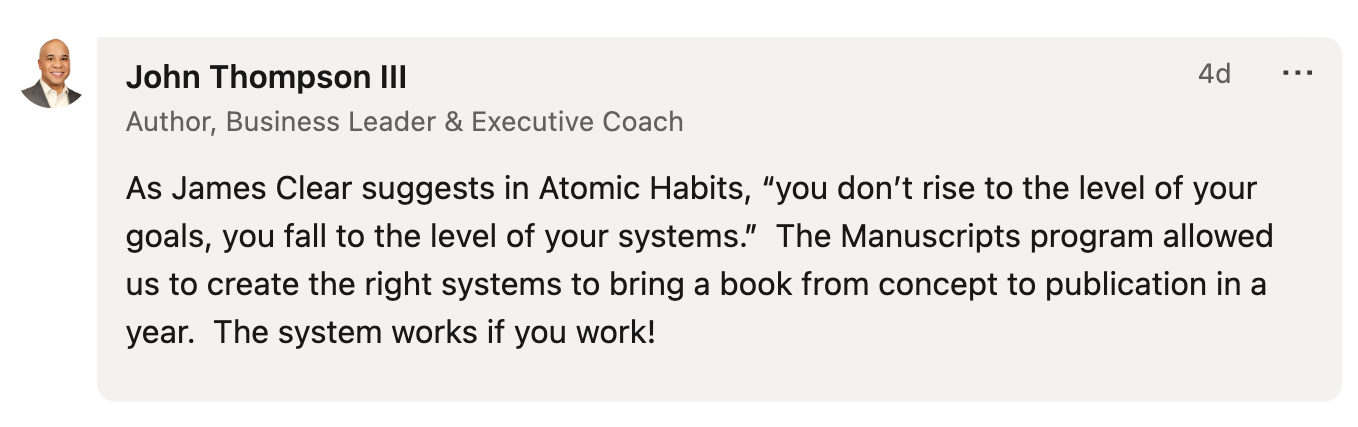
“You do not rise to the level of your goals. You fall to the level of your systems. Your goal is your desired outcome. Your system is the collection of daily habits that will get you there. This year, spend less time focusing on outcomes and more time focusing on the habits that precede the results.” - James Clear (Atomic Habits)
Systems create outcomes. We just have to build yours. Let’s talk about designing your writing process and your writing systems.

Designing a Writing Process

I’m a big fan of the concept of Design Thinking, an approach pioneered by the Stanford D School to help people iterate and prototype new solutions and products.   Why would design thinking have anything to do with a writing process?  
  1. If you’re writing a book, it’ll require a multi-month process. 
  2. It’ll require you to write regularly. 
  3. It’ll force you to get through ‘writers block’ or periods when you just don’t feel like writing. 
  4. You need a process to finish something big. 
Design thinking works because you need to design a process that works for you. The product is your process. So we want to design a solution that will work for you, that can change with you, and that’ll enable you to succeed.   There are five ‘phases’ to design thinking, and we are going to leverage all five to design (and redesign) your writing process:
  • Empathize
  • Define
  • Ideate
  • Prototype
  • Test

STEP 1: Empathize

This may seem a little counterintuitive, but you are the audience for your writing process. And as much as you probably think you know yourself, it’s often harder than we imagine to truly ‘know thyself.’ This isn’t about an aspirational or hopeful view of ourselves. We want to focus on the actual realities.  Here are the two key questions to ask yourself about designing your writing process:

When I have typically written bigger things (term paper, thesis, work project), what is my style?

  • I set aside time every day or multiple times a week and try and chip away at it. (Habit Writing)
  • I don’t work on a set schedule, but usually, I write in bigger sessions — 3-6 hours of intense writing — is how I make progress. Usually, several of those are how I write. (Episodic Writing) 
  • I get most of my best work done right before its due — sometimes that means late nights or intense pushes, but I get it done. (Deadline Writing)

What makes you most nervous about writing your book?

  • I feel uncertain about the book's direction — as I’ve begun to explore, I have doubts if it’s as exciting as I originally thought. (Boredom)
  • I feel energized during the sessions, but when I’m working on it by myself, I get in my head. (Loneliness)
  • I feel like an imposter — am I qualified to write this, and when it's finished, will it be any good? (Insecurity)
  • I am very busy, and I want to do the book, but I'm nervous I have sufficient time. (Fatigue)
  • I am not sure I can do it. I’m not a great writer and am worried I can’t write a whole book. (Uncertainty)

STEP 2: Define

I encourage authors to combine these two terms to define themselves — you may want to pick multiple categories in each question, but force yourself to pick the answer that is most like you. This creates a simple way to define yourself. I am a Deadline Writer who struggles with Fatigue. I am a Habit Writer who struggles with Loneliness. I am an Episodic Writer who struggles with Insecurity.

STEP 3: Ideate

Now here’s the fun part. You’ve defined how you typically write (not an aspirational version but your reality), and you’ve defined what makes you most nervous about this writing project. What are ways you could potentially solve this? I am a Deadline Writer who struggles with Fatigue.
  • Cut out some activities for the next few months.
  • Scope the writing project smaller and set weekly deadlines to deliver content.
  • Schedule time each week with a writing group.
I am a Habit Writer who struggles with Loneliness.
  • Join a Zoom writers' group.
  • Recruit a friend who has wanted to write a book to write hers at the same time.
  • Hire an editor and do weekly calls.

STEP 4: Prototype

There are endless solutions you could try, and at this point, you want to pick the idea or approach you’re most intrigued or excited about. Remember, this isn’t the solution . . . it’s a prototype, an experiment, or a trial.   I advise people to prototype a new writing process that you can begin tomorrow and try for two weeks.   How do you prototype? Usually, it’s an incomplete or a partial solution based on what you can do quickly — but it may not be perfect. Here’s an example: I am a Deadline Writer who struggles with Fatigue.
  • I am going to schedule time each week with a writing group.
Now you probably can’t find a writers' group that you can join tomorrow, and you don’t want to pay to join a group if you aren’t sure it’s for you. You need to prototype it. How? What does a writers' group require?
  • A group of writers
  • A shared time to write
Consider this idea. Send out a text message to five people in your life. “I’ve got a writing project I’m working on — looking for a bit of shared accountability. Want to jump on zoom (or meet at a coffee shop) this week for some shared writing time?” If one person says “yes” then you’ve got your group.

STEP 5: Test

Now you’ve got your prototype, and you’re going to run it for two weeks. You need something to test this approach against.   Create a hypothesis: I’d like to write an average of 2,000 words each week for the next two weeks. Write this down.  Run the experiment, and see what happens. If it works, great — now you’ve got a new writing process. If it works for a while and then stops working, go back and change something such as a new prototype or perhaps even a new definition.  

* * *

The writing process isn’t some static system. It’ll evolve and change, but the best part is once you have a process, you can use it to write anything! If you have an amazing idea for a book but no process to write it, you’ll probably never finish the writing. But if you have a writing process that regularly and efficiently gets words on the page, you’ll eventually figure out a killer idea through the writing.  Have fun building your writing process. 
Eric Koester is the founder and CEO of Creator Institute, a b-corporation whose mission is to inspire, teach and support tomorrow’s creators — authors, podcasters, speakers, entrepreneurs, corporate innovators and course builders. Through his work he’s coached nearly 1,000 first-time creators. He is also a Professor of Entrepreneurship & Innovation at Georgetown University and the school’s only two-time entrepreneurship professor of the year, faculty at Growth University, and the executive director of the Intrapreneur Institute, which researches, trains and develops future innovation leaders.

Read more...
  Prev1…34

Recent Posts

  • Navid Nazemian
  • Dr. Christina Cipriano
  • Jen Marr
  • Scott White
  • Raven Jemison

Recent Comments

  1. Suma Mathai on Righting My Writing: What It’s Like to Work With a Developmental Editor
  • Write Your Book
  • Publish With Us
  • Book Launches
  • Codex
  • Blog
MANUSCRIPTS © Copyright 2025. All Rights Reserved.
  • Write Your Book
  • Publish With Us
  • Book Launches
  • Blog